Wednesday, December 21, 2005

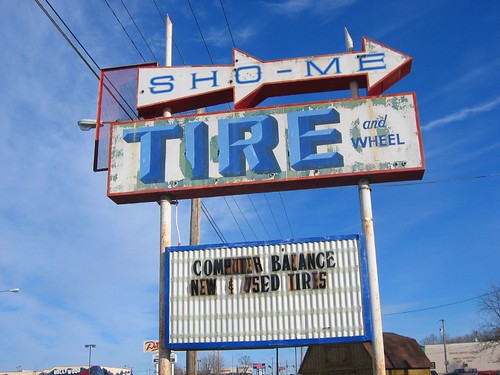
Missour-ah signage

Flickr photo


I was in Springfield, Missouri for work last week, and I was really surprised and impressed with the number of old, unique signs. Over on Flickr, you'll be amazed by two shots of some amazing Glo Laundromats signs, and a strip mall called "Country Club Plaza" that has an old orange sign with an analog clock on it. Good stuff.

Thursday, December 15, 2005

On the trail of the Meth Capital

Meth is known by many names -- speed, ice, crank, crystal, glass -- and, by many accounts, it continues to spread throughout the US. Whenever a conversation turns to the subject of meth, someone inevitably identifies some American city as Our Meth Capital. Others in the conversation usually disagree -- "Des Moines? I thought Fresno was the meth capital," "No, it's Gainesville, Florida," "I thought it was somewhere outside Phoenix," and so on.

Judging from the cities that are thrown around in these conversations, the meth capital should be (a) poor, (b) white, (c) somewhat small, but not unheard of, and (d) known for heavy industry, agriculture, or tourism. Of course, the Internet has something to say about the location of our meth capital. Most seem to agree that it's in California, probably somewhere in the Central Valley now that the tweakers have been run out of Riverside and San Diego counties.

Nominations for our nation's meth capital include:


  • The LA Weekly, California's Central Valley: "What Colombia is to cocaine, the Central Valley of California is to meth labs."

  • Sierra Magazine, California, Arizona, Missouri: "California, Arizona, and Missouri vie for the dubious honor of meth capital of America ... in terms of sheer volume, California has always been and remains Numero Uno."

  • Austin American-Statesman, Not Texas: "Should the bill not pass, Estes warned, 'we can count on Texas becoming the meth capital of the United States.'"

  • Missouri Senator Kit Bond: Missouri: "Unfortunately, Missouri is the methamphetamine capital of the United States."

  • The Southern Illinois Daily Egyptian, Missouri: "The concept is coming over from Missouri and is spreading across the area."

  • Slate, Everyone needs to chill: "Submit the search terms "methamphetamine capital of the world" or "meth capital of the world" into Nexis, and it spits back almost 70 citations between 1983 and 2005, with many writers and sources disputing the capital's precise GPS coordinates."

Tuesday, December 13, 2005

Art / Say it isn't so, Gocco.

Nooooo! Print Gocco, the ingenious, addictive Japanese home screen-printing press, is (apparently) being discontinued. Gocco supplies have been scarce lately (at Pearl Paints on Market, anyway), so I called Welsh Products. As I was ordering some bulbs and screens, I commented about the scarcity, and the woman on the other end said, "Well, they have discontinued it, you know."

[Sound of phone hitting floor]

She said that Riso would continue to manufacture ink, bulbs and screens for three years, but that they're ceasing production of the B6 press (the classic) very soon.

Immediately after I hung up, I verified the news on the Internet -- because it is so trustworthy in news of this nature -- and quickly found a site dedicated to the preservation of Gocco: Save Gocco. I couldn't find any official reference, but MAKE magazine seems to believe the hype as well. Gocco's US site doesn't mention anything about it.

Thursday, December 8, 2005

Dust it off / XTC, Skylarking

Skylarking
Here's my question: How did this become the "Dear God" album, considering at least half the songs on it are as good or better? Damn you, Sarah McLachlan. I hadn't listened to it since maybe 1995, when Ted and I played the shit out of it. We both loved the Beatles, and I had a fondness for the synthy 80's style. This album combines these qualities, and adds a little indie rock sensibility as well.

Now that the Cars and Hall & Oates have been on heavy hipster rotation for the past year or so, I'm surprised that XTC haven't seen some props, especially for this album. Compared to other XTC albums, the vocals are more blended with the rest of the sound, rather than held above it, which reduces the saccharine edge of later albums (Oranges & Lemons, for instance). Maybe XTC just doesn't have the kitschy cache of other 80's bands, who knows?

Incidentally, you can read more about the most well-known song on the album. Here's a fan of Sarah, explaining why it's okay to love Sarah even if she questions the existence of God: "I do not believe that you should rule out a whole singer or album just because of one song that you do not care for."

Wednesday, December 7, 2005

Dust it off / Sleater-Kinney, All Hands on the Bad One

All Hands on the Bad One, babyMost of my records, CDs and tapes sit idly in crates and on shelves, so here's what I'm going to do: Every so often, I'm going to dust one off and see what it sounds like. Dredge the archive, and take a good long listen to something I haven't heard in 2+ years.


Tonight, I begin the experiment with a randomly selected record: Sleater-Kinney's All Hands on the Bad One, which I'll admit I haven't listen to in three years. Maybe four.


Here's the thing about Sleater-Kinney and me. I'm probably one of the very few San Franciscans (of a certain age and neighborhood) who *likes* them but doesn't *love* them and sometimes wishes they would cool it with the too-often shrill vocals. But of course everyone knows they're politically-active feminists who play punk rock, so what's my problem?


Let's talk about Bad One. It's got great moments: the title track and "The Professional" are rockin and fun -- even after five years, they're a couple of the all-time great songs to listen to while riding a bike. The problem is that, for the most part, this album is huge step away from their early, raw sound, which had a lot less Heart-esque power ballad voice. Songs like "Milkshake n Honey," and "Ballad of a Ladyman" feature this voice, which for me is the element of their sound that rocks the least. (It comes down to this: If Carrie Brownstein harmonizes with Corin Tucker on a song, chances are that I'll like it).


I'll say something nice about them: I saw them move the crowd in a serious way at Dolores Park one summer. Their fans were freaking out, and the band itself was having fun and sounding good -- even songs I didn't like were pretty great. I really wish their albums captured this better. But like anything, their sound can't be all things for all people, and they seem to please some group of people everytime they put out an album, so more power to them.

Art / Robert Adams at SFMOMA

Flickr photo
I'd never heard of Robert Adams before I saw his show at SFMOMA. Called "Turning Back," the photos document the destruction of the old-growth forests that Lewis & Clark passed through on their journey westward. The title refers to the implications and complications of westward advancement. When Lewis and Clark reached the West Coast, they turned back and headed east; the vast devastation in Adams's photos conveys the sense that -- these days -- there's no turning back.

"Turning Back" is bound to strike a chord with people. It evokes indelible American ideals and icons -- the natural beauty of America, the promise inherent in the West, the bravery of Lewis & Clark -- and presents it in a format and style eerily reminscent to another photographer named Adams -- Ansel. Whereas Ansel's classic photos endeavor to communicate the vastness and beauty of America, the best of Robert's manage to convey an equally vast devastation.

While I walked through the show, I thought a lot about my hike on the PCT, which took me through a few of the same forests featured in the show. As I approached the northern part of the west coast, I was pretty curious about the clear cuts. Of course I knew that it would be depressing, but really I had no idea what to expect. I imagined a sort of Lorax-y landscape of smooth hills dotted with little stumps.

As I hiked through the vast clear cuts of Northern California, Oregon and Washington, I was stunned *not* by the absence of trees, but the obvious brutality surrounding their removal. In the newer clear-cut areas, there was upturned earth everywhere, huge mounds of soil, mangled stumps -- I've never been on a battlefield, but there's probably more a few similarities between the two. In some places, the dirt mounds and fallen trees completely obliterated the trail, and we had to do some pretty thorough route-finding before we made it through.

In the areas that had been clear-cut years before, the trees grew in thick clumps. One didn't so much hike through them as swim, or claw, or climb. The small trees were themselves fighting for space, and their branches were so densely interwoven that the ground was invisible for hundreds of yards around. In the mornings, before the dew evaporated, one could easily get soaked in the space of twenty yards while pushing through the branches.

Adams's photos convey the brutality and upheaval well, though I really wished that context had been provided along with each photo -- where was it taken? when? what used to be there? I wanted to connect with specifics of geography and fit the pieces together.

Wednesday, November 30, 2005

Things to do in Minneapolis when you're cold

Flickr photo


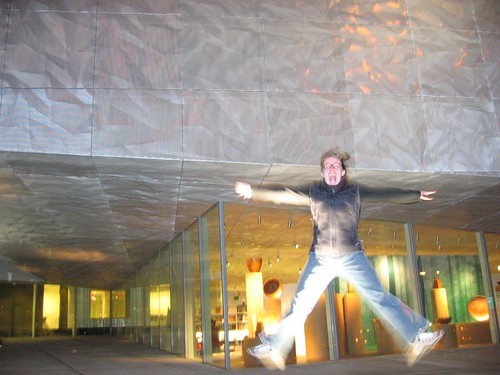
The Twin Cities are still full of good times, especially when the mercury plunges. A couple of weekends ago, I enjoyed the chill with my friends Fish, Katie and Becky (pictured, in front of the new wing at the Walker).

The highlights:


  • Vietnamese sandwiches at the Jasmine Deli on Nicollet. Their sandwiches are fabulous, especially the BBQ chicken.

  • The new and improved Walker. Twin Cities residents seem ambivalent -- some love it, others are underwhelmed -- but I was really impressed with the way that the new wing blends into the old, and the manner in which they space itself still seems intimate and surprising. Plus, it's open late on Friday nights; how great is that? The Walker's video installations have always been great, and I was really glad to catch a few moments of Jem Cohen's "Lost Book Found" and "Blood Orange Sky" as we walked through -- worth reading: A long, detailed interview with Jem Cohen by Rhys Graham. Also, an entire room dedicated to Sherrie Levine, a cabinet full of Fluxus stuff (still cool after all these years of imitators), and a great exhibit of Huang Yong Ping that included some live spiders and scorpions.

  • Good, solid Midwestern dishes prepared Chez Panisse-style (local, organic, a little French) at Auriga. They also serve Kona coffee.

  • Weird Norweigan snacks and crazy folk-art murals at Ingebretsons, a store that sells all sorts of Scandanavian crafts and gifts. Even weirder because it's in a somewhat bombed-out part of Lake Street.

  • A little waterfall in the middle of the city, Minnehaha Falls. Totally worth seeing, especially in winter.

  • Fish and Katie's totally awesome 60's-style neighborhood movie theater, The Riverview, that shows fairly new movies for THREE DOLLARS. Are you kidding me? Plus, it has been totally restored, and totally reminds me of the heyday of Kansas City's Glenwood, which I think has recently been gutted of all the 60's schmaltz.

Monday, November 7, 2005

Kansas / The best state quarter so far


It just happens to be from my home state. Nice work, Kansans.

Music / Konono #1 lights it up


Last night, Konono #1 played the Palace of Fine Arts. Before the show, I was a little worried that their scruffy, off-kilter sound may get washed-out by the fancy sound-system of the PoFA, and that they may end up sounding like lame-ass Ashkenaz-style "world music."

But from the first moment, they totally ruled, and their signature sound -- with homemade electric pick-ups for their ikembes (thumb pianos), dented metal discs serving as cymbals, and MASH-style megaphones as a PA -- was faithfully recreated. The PoFA is a chamber-music-style venue with cushy seats and little room to boogie, but most of the crowd was standing and dancing by the third song, and groups crowded at the sides of the stage to improvise a little dance floor. Their final song was an epic, 45-minutes trance-inducing jam that had everyone clapping and chanting along with the track-suit-clad front man.

Most remarkable was the vitality of it all, the sense that there was something essential and healthy and real being created. Each band member's intense, insistent presence was spell-binding, especially the older guy in the blue baseball hat who traded off with Mingiedi (the leader, pictured) on the thumb piano and percussion. He was locked into a serious groove the whole night, banging out precise rhythms, and belting out crisp, deep monotone harmonies that were jarring but somehow perfect. It's not often that San Francisco crowds get up and shake their asses, so it was especially impressive that Konono #1 made dancing in a concert hall on Sunday night seem totally natural.

Thursday, November 3, 2005

Art / LACMA garage RIP

Flickr photo


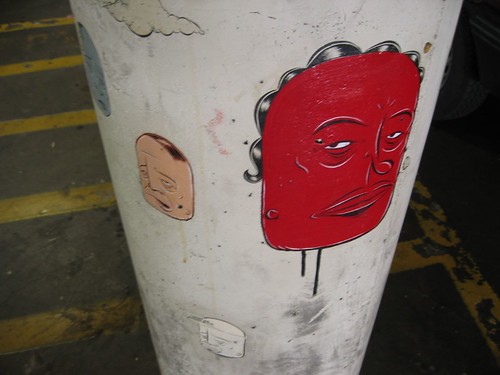
Soon, the garage outside the LA County Museum of Art is getting torn down to make way for some big new building. Unfortunately, it's got some really excellent murals by Barry McGee and Margaret Kilgallen that I checked out when I was there a couple of summers ago.

The LA Weekly says:
Now's the time to check out the celebration of street art it has become since October 2000, when husband and wife team Barry McGee and Margaret Kilgallen were commissioned to bomb the second floor of the structure in commemoration of the show "Made in California."

Over the last five years, Kilgallen's smoking, trudging, scowling women and McGee's signature sad-sack faces and meticulously drawn messages have inspired uncoerced homages from several locally and internationally known artists: N.Y.-based graffiti trio FAILE's collage stencils; Spanish tagger PEZ's bubbly alien figures, and Obey Giant guru Shepard Fairey's looming wheat-paste policeman.

It wouldn't be as sad if Margaret K. was still around to bomb another garage, but the fact that she's not makes the disappearance of this free and public place even harder to take. Sucks.

The whole story: "Oil on Concrete".

UPDATE: An excellent critique of LACMA's decision to tear down the garage, written by art critic and blogger Tyler Green.

Art / Muhammad Ali likes soul food

Flickr photo


One of my favorite neighborhood art spots is called Creativity Explored, "a nonprofit visual arts center where artists with developmental disabilities create, exhibit, and sell art." Or so it says on its website.

At first, I felt conflicted about Creativity Explored. Much of the art is geniunely impressive, and a few of the artists are quite talented and produce truly beautiful work. But the greatness is complicated by the artists' disabilities. So many works seem truly unique, yet you can't shake the feeling that you're admiring the product of the very thing that prevents the artist from living a "normal" life.

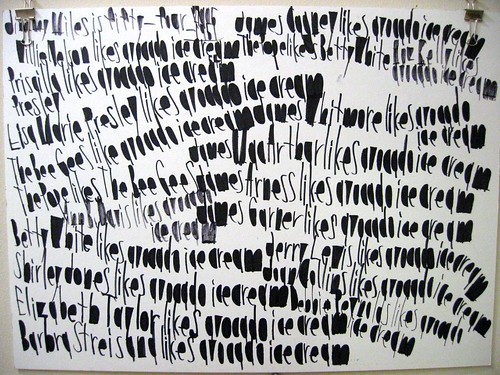
The fact is that I really like a lot of it, especially the handwriting/drawings of John Patrick McKenzie. John's handwriting is bold and jaunty in a way that, at first, makes it look like a cross between graffiti and first-grade. But then beyond the initial impression, it becomes clear that the page is often organized very precisely. As he tends to color in the enclosed areas of each letter -- the interior of an R, D, P, etc -- the page takes on a heavier graphic dimension.

Content-wise, each work of John's works is thematic, though "thematic" may be too fancy a term for it. Each contains a set of words or phrases that is shuffled in a variety of ways throughout the work, though some others just contain seemingly random individual words written again and again. Humor (probably unintentional) often arises from his selection of the names of stars of the 60's and 70's in his work, as well as fellow Creativity Explored artists.

Generally, he'll pick a subject -- for instance, the 1964 Chevy Impala -- and he'll write a series of statements about how certain people feel about the subject. "Bruce Lee likes the 1964 Chevy Impala. Doris Tokuda likes the 1964 Chevy Impala," etc. The work above has a slightly different arrangement: "Sylvester Stallone likes Chef Boyardee ... Muhammad Ali likes soul food."

Sometimes, the subject of the work veers away from the literal. John has developed a sort of code for referring to all sorts of subjects, so you'll see phrases like "redneck pizza sheriff," "spring chicken," "cold turkey," "avocado ice cream," and many others used in strange contexts. Sometimes they're code, sometimes they're just what they are. Someone once told me that "avocado ice cream" is code, but recently a teacher at CE theorized that John had recently eaten at Mitchell's.

Like much outsider art, John's work is exotic -- the and it's hard to admire and discuss it without fetishizing the condition that contributes to it. But you could also say that John's work makes this less of an issue because it is so visually appealing, and often so poetic.

The SF Weekly wrote an article about John in 2002: "Osama bin Laden dislikes kelloggs frosted mini wheats"

Good time on a California jury

For the last three days, I served on a jury in a civil trial in San Francisco Superior Court. It was a personal injury case stemming from an auto accident on the Bay Bridge in 2002. The plaintiff sought cash for physical and mental suffering, inconvenience, loss of enjoyment of life, and about six other things. I had some idea of how totally jacked California personal injury law is. After seeing the way that this case played out, I am shocked and depressed by it.

The facts. There was no question that the defendant (a round-ish kid from outside Sacramento) rear-ended the plaintiff (an Asian lady from El Cerrito). The question was: Was there enough evidence of actual harm to award some kind of money? The plaintiff's car was unharmed by the collision. She drove home immediately afterward. An expert witness argued that the collision could not have been more than a slight bump. In my opinion, the plaintiff offered no evidence to support her argument. She claimed various types of harm: 18 months of back problems, inability to have intimate relations with her husband (ouch), general family dissolution. But her tearful testimony was the only evidence of her suffering. There was no testimony or deposition from her doctor, no medical records, no police report, no testimony from her husband or kids; moreover, she continued to work immediately after the accident and admitted that she missed no work -- including business trips to China and Seattle -- as a result.

Our task. We had a total of four questions to answer; but if we ruled "no" on any of the first three, our work was done. Case closed. The first question: Was the defendant was negligent? If we agreed he was negligent, question two: Was the plaintiff harmed? If so, question three: Was the defendant a substantial factor in the harm? Finally, if he was: How much money should be awarded for the harm?

1. Was the defendant negligent? Umm, yeah. The guy rear-ended her. Hard to say he wasn't. Still, you had to feel bad for him. He was working at a pizza place at the time of the accident, and you had to know that he was fearing some kind of huge verdict. Nevertheless, his testimony was unconvincing. A "reasonably careful" person would not rear-end a car in that situation, even if he was sneezing, as he claimed. About half the jury initially wanted to say that he was not negligent, but the rest of us had a hard time ruling that he wasn't. He wasn't paying attention. A reasonably careful person would have been paying attention. After 10 minutes of discussion, we came to a decision: 12 yes, 0 no.

2. Was the plaintiff harmed? This is where it got testy. I personally believed that if we said "yes" to this, we were going to have to award damages. So I argued (at length) that she wasn't harmed, and at first 7 other jurors agreed. We only needed one more to turn to our side to win -- in California, you only need 9 out of 12 jurors to agree on a point to come to a decision.

Unfortunately, one of the characteristics of harm was "inconvenience." The minority argued -- persuasively enough, as it turned out -- that the fact that she had to stop on the Bay Bridge during crazy weekend traffic was enough to say that she was harmed. Eventually, they had the required 9, including three other young guys who I thought were going to be faithful allies (they were from the Mission, Upper Haight, and Potrero Hill). Interestingly, the other two who believed that she wasn't harmed were women: one was an older Asian lady (Sunset), and another was a young woman from the Marina. Final score: 9 yes, 3 no.

3. Was the defendant a substantial cause of the harm? It was really hard to say "no" to this if you said "yes" to the above question because of inconvenience. I started to get really nervous that we were going down a path where we were going to award her some money because she got bumped on the Bay Bridge, and claimed to have incurred all sorts of hardship. Again: 9 yes, 3 no.

Aside: It was pretty clear that the accident was traumatic to the plaintiff; she cried throughout the trial, and her rendition of the accident made it sound pretty scary. It happened over the weekend, so the traffic was crazy, and the defendant handled himself badly. BUT, she didn't file a suit until two years later, didn't keep receipts for medical treatment, didn't have any testimony from doctors or family members. Without any of this, it seemed insane, really, to say with any certainty that she was harmed. It's not like it's hard to produce this evidence. C'mon!

4. How much is the plaintiff entitled to for her mental/physical suffering? At this point, the foreman used the whiteboard to write out each element of physical and mental suffering (loss of enjoyment of life, inconvenience, etc), laying out a framework where we would agree on a value for each thing. In California, juries are given no guidelines for determining the award; we're left to our own devices.

The foreman said, "I'm just going to throw out a figure. $5000." Upper Haight guy said, "$3000." Another two women chimed in with $3000. Immediately, there were four people who wanted to award money for her unsupported claims.

Luckily, Potrero Hill and Mission guys were even more passionate than me about this, and they immediately articulated an argument that I hadn't expected: that inconvenience on the Bay Bridge has a monetary value of ZERO dollars. The three Asian ladies immediately agreed, as did the Marina lady.

The foreman kept proposing figures -- "Okay, how about $2000?" -- but Potrero Hill guy interjected: "Hey, we've got 8 people who believe that she shouldn't get anything. You're in the minority. You need to come to us." Eventually, we were arguing about whether or not to award $250. Finally, a little after 4pm, the foreman cracked: "Okay, fine. Zero dollars." And justice was served: 9 $0, 3 $250.

But the depressing thing was how easy it was to assign monetary damages, how much the logic of the law seemed destined to lead to it. Upper Haight guy was brainwashed by it. Even though he could never articulate a pragmatic reason why she should get any money, he kept referring to the jury instructions and saying, "I'm just following these rules. She was inconvenienced, and now we have to assign a value to that." The foreman was sympathetic -- he had family members who had been in a much worse position and got no money -- which he acknowledged was not a valid legal reason, but it took him an hour before he abandoned this.

As the verdict was read -- negligent, harmed, substantial cause of harm -- the defendant looked scared, and his attorney looked depressed. Then, the big fat $0 of damages, and everything changed. The plaintiff's attorney slumped, and the plaintiff began crying again. The defendant was relieved, and the judge actually looked relieved as well.

Justice was served. Barely.
Thursday, October 6, 2005

Photos / Underwater buildings

Flickr photo


Sometimes, the crappy lens on my Motorola v220 produces interesting effects. Recently, it has started compressing the depth of field, and at the same time, arbitrarily fuzzing out objects. When directed at buildings in full late-afternoon light, it actually makes things look like they're in an aquarium.

Friday, September 30, 2005

Art / Graphic design for public transit

Hong KongTokyoSF MuniParis
If you're like me, one of your favorite parts of seeing new cities is checking out the logo(s) of their public transit system. Nowadays you don't even need to travel to these cities to appreciate their variety; here's a site with an amazingly thorough catalog.

Thursday, September 29, 2005

Fresh Air interview w/ Mike Mills

Mike Mills is a graphic designer, director of many excellent music videos (among them: "Kelly Watch the Stars," by Air, the one with the 70's-looking slow-motion ping-pong players), and all-around aesthetic bad-ass. Terry Gross interviewed him on Fresh Air a couple of weeks ago, and you can check out the archived version on the NPR website. It includes a funny anecdote about his experience as an apprentice for a well-known Scottish artist -- at the risk of giving away the ending, Mills didn't assist in the creation of the work as much as he created the work for the artist, who was too hungover to do it himself. Here's a really comprehensive collection of his video work, including "Kelly Watch the Stars."

Incidentally, when I was growing up, a different Mike Mills was the bassist for my favorite rock band c. 1985-88 -- REM. You can hear his thin, poignant harmonizing on Murmur, Reckoning, Fables of the Reconstruction, Life's Rich Pageant, Dead Letter Office, and Document. (Don't bother with anything after Document; it's all downhill from there). Let's hear it for all Mike Millses!

New Yorker cartoon formula exposed!

Flickr photo


Take one character each from column A and column B, place them in one of column C's settings, and voila! You have the makings of a New Yorker cartoon. Supposedly, this was the doing of a group of NYer cartoonists at a recent festival.

Monday, September 26, 2005

Burgers in SF

Flickr photo


After a chill afternoon at China Beach, we checked out some burgers at Bill's Place, which made me think about all of the good burgers to be found in San Francisco:

  • Bill's Place (pictured) grinds its own, and names its burger platters after local celebrities. Extra credit for the chandeliers and non-mayo cole slaw. On the downside, it's unjustifiably pricey. $10 for a burger? Maybe at Zuni, but it seems weird to pay this much at a diner.

  • If you're interested in diner-style ambiance more than good-tasting burgers, you can check out Joe's Cable Car. I really wish that the burgers tasted good there, but the reality is that they don't.
  • For fake retro ambiance, high tourist quotient and really mediocre burgers, Mel's is your place. There are at least three very unconvenient Mel's locations, if you're Mission/Lower-Haight based.
  • Slow Club has (or used to have) a good yuppie burger -- sprouts and fancy aioli, on some kind of Euro roll. Being from the Midwest, I dislike froofy interpretations of burgers, but in weaker moments I have been known to order this burger. And enjoy it.
  • Speaking of froofy, Zuni serves a burger amidst its generally tasty Cali cuisine. In 1996-ish, I could not bring myself to admit that it was good; in 2005, I can.
  • On cold nights, Zeitgeist can ring your chimes with a good char-burger. On warm, busy nights, expect extra char.
  • BurgerMeister and Burger Joint are all about happy cows (Niman Ranch beef), sterile, fluorescent-lit dining rooms (creepy) and, in the end, similar burgers. Hipsters split hairs about which is better. I call it a tie. (But the Meiser has Mitchell's ice cream.)
  • I'm a recent convert to the virtues of Big Mouth in the Mission. Quality control is in full effect on both fries and burgers, plus greasy-spoon atmosphere distinguishes it from the sterile environs of the BJs and BMs of the world.
  • Everyone talks about Barney's Gourmet Hamburgers but I personally don't see what the fuss is about. It's not that I dislike white people, but it annoys me that the owners avoid all but the whitest of white neighborhoods -- North Berkeley, North Oakland, Noe Valley. Dude, next stop: Mill Valley.

    There are lots more. I'll update soon.

Thursday, September 15, 2005

Architecture / Seattle library

Flickr photo


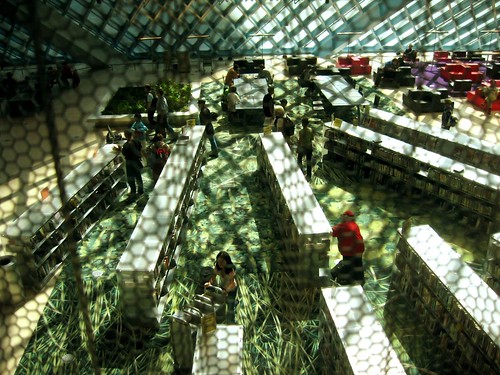
I took this picture in a small atrium overlooking the lobby of the Seattle Library, designed by Rem Koolhaas and opened a year ago. As Mara and I enjoyed the cool, green light, we overheard a conversation that went something like this:

Middle-age woman to her husband: I can't believe they spent so much money on this thing.

Husband: It's absurd. What's in a library? Books. You don't need all this other stuff.

Middle-age woman to Mara: What a waste of money, right?

Mara: [Flabbergasted]

People raise the same argument when cities build new sports stadiums. Of course, stadiums bring in huge amounts of revenue and, the last time I checked, libraries were free. On the other hand, stadiums house teams owned by zillionaires who, the last time I checked, could probably afford to build the stadiums themselves.

In any case, the taxpayers of Seattle have contributed to the construction of an amazing public space where EVERYONE can go, read, hang out FREE OF CHARGE and be inspired by the wisdom of the ages surrounding them. I can't imagine a better environment in which to do this. Citizens of Seattle, I salute you.

Tuesday, September 13, 2005

Following the Roberts confirmation hearing

Law nerds around the country are providing interesting commentary of the Roberts confirmation. SCOTUSblog provides a blow-by-blow account of the posturing and intermittent questioning of the senators alongside interesting legal commentary, but it's a blog, so you have to scroll down to the bottom and read upwards if you want to read chronologically.

Balkinization, a blog that includes many quite interesting essays by Yale Law professor Jack Balkin, has an interesting discussion about why Democrats should not confirm Roberts. Balkin recently published an interesting piece in Slate about originalists and the concept of a living constitution: "Alive and Kicking: Why no one truly believes in a dead Constitution."

If you're willing to sift through the details -- and each memeber of the Senate Judiciary Committee tends go into excessive detail before getting to his/her question -- the NYT has raw transcripts: Day 1, Day 2.

Thursday, September 1, 2005

Termites eat New Orleans

After Hurricane Katrina, the recent Harper's magazine feature about the uncontrollable, unfathomed termite infestation of the French Quarter seems downright eerie. Equal parts information and meditation, Duncan Murrell's "The Swarm" is an effective, moving blend of first-hand reporting on blizzard-like termite swarms, spooky interviews with insect experts, and genuine Southern gothic moments:
Where the Formosans are foraging -- in the studs of a wall, for instance -- the carton sometimes takes the shape of the very thing they're eating. Pest-control operators in New Orleans told me many of stories of ripping out drywall to expose what looked from a distance like solid two-by-four framing pieces, only to find that they were looking at carton nests, the ghosts of a wall long since consumed.

It also provides a peek into the world of the termitologist, touching on the tragic tale of a manic-depressive South African entomologist who became so obsessed with termites that he began to view their behavior in perhaps overly sophisticated terms:
[Eugene] Marais believed that colonies of termites were distinct, compound organisms not unlike the human body, that every component from queen to worker served a function not just analogous but identical to the function of our own hearts and livers and brains and blood cells. Marais thought that the termite colony lacked only the power to move together as one organism, and that someday they would develop even that skill.

Next on my reading list: Marais's "classic work of obsessive observation," The Soul of the White Ant.

Wednesday, August 31, 2005

Art / Palestine: "The ultimate activity holiday destination for graffiti writers"

Palestinian wall - 1 Banksy wall - 2 The British street artist Banksy just painted nine provocative murals on the wall that separates the West Bank from Israel. The sardonic quote in the title is Banksy's reflection on his work there. He goes into a little more detail on his site. The Guardian and BBC both covered it, and there is at least a little disagreement over the meaning and relevance of politically-motivated street art here and here.

While we're on the subject of Banksy, here's my previous favorite project of his. As the BBC sub-head describes it, "Fake prehistoric rock art of a caveman with a shopping trolley has been hung on the walls of the British Museum."

Friday, August 5, 2005

Art / Enter maximalism.

Flickr photo


An article in yesterday's NYT House & Garden section extolled the virtues of clutter. Kristen summed it up nicely: Maximalism is the new minimalism.
"Minimalism is easy to copy," Ms. de Lorme said at her unabashedly messy desk on a recent morning. "Everybody can do it."

Nevertheless, maximalism isn't as easy as it sounds. The author visits a Barry McGee exhibition at Deitch Projects in New York and finds that clutter must be as carefully arranged as non-clutter if it is to work:
Op-art panels on the walls. Graffiti everywhere. And one wall I stared at for a long time was covered with small, framed pictures densely hung at odd angles, some layered on top of one another. Like the whole massive installation, it looked random. Of course, it wasn't.

The thing is, Barry McGee was maximal so long ago -- Bay-Area-Now-1996 long ago -- that it's strange to use him as an example of a current maximal trend. I guess well-executed maximalism is timeless.

The photo above is from Barry McGee's maximal mural at the Museum of Victoria (fall, 2004).

Wednesday, August 3, 2005

Baseball / Palmeiro-zol

The Baseball Hall of Fame is filled with guys who cheated, played dirty, were terrible role models, drunks, jerks, domestic abusers, the list goes on. If any of these things disqualified players from eligibility, guys like Gaylord Perry & Whitey Ford (cheaters), Mickey Mantle (a great guy, but a drunk), Ty Cobb (a jerk) and many, many more would have been denied entry.

With the exception of the Pete Rose affair, history has ruled that only two things matter when it comes to HOF criteria: statistical milestones and World Series rings. And for Rose, all would likely be forgiven if he would suck it up and apologize.

In another few years, we'll add some more characters to the Hall's rogue gallery -- the juicers. One of them will be Rafael Palmeiro, who testified before Congress that he had never taken steroids. Palmeiro punctuated his testimony with finger-jabs at the assembled Congresspeople, a gesture that now seems oddly similar to the technique used by Jose Canseco to inject steroids into Palmeiro's butt. Yesterday, Palmeiro was exposed as a juicer, and the NYT reported that he used the real stuff rather than some super-charged multi-vitamin:
Palmeiro said Monday that he had never intentionally taken steroids, but stanozolol does not come in dietary supplements and is among the most popular steroids on the market. It can be ingested or injected and usually remains in a person's system for at least a month.

"It's a mildly strong to strong steroid," said Dr. Gary Wadler, a professor at New York University who is an expert in sports doping. "Potent is the word I would use."

Palmeiro will be joined by at least three other juicers in the Hall: McGwire, Bonds and Sosa. I don't begrudge these guys. They definitely weren't the only juicers in the game, and they would have been great players without the 900-foot moon-shots. On the other hand, I think that the Hall should find a way to express and interpret the unsavory side of baseball: Induct Raffy and rest (Rose, especially), and set up a section of that constructively discusses and contextualizes the behaviors and achievements of those players who sought extra-curricular assistance.

Baseball's good guys probably don't lose any sleep over this, but I still think that the Hall should find a way to distinguish guys like Robin Yount & Mike Schmidt (and in the future, Greg Maddux & Tony Gwynn). They deserve to be recognized as fair players in times when players sought unfair advantages.

Rust Belt road trip

Rust belt!


Pittsburgh. Buffalo. Niagara Falls. Toronto. Detroit. It's not exactly Route 66, but it was hot.

The whole trip is on Flickr.

Wednesday, July 20, 2005

I love Michigan in the summer.

Flickr photo


10 things about Gabe & Yoshi's wedding:


  • The bride and groom. Our golden couple. The whole weekend was a perfect reflection of what we all love about them.
  • Kalamazoo. Charming and fun. Shady trees, greasy spoons, a surprisingly fancy art museum.
  • The winding, tree-lined streets of Kalamazoo. Grid-less! Baffling! London, Boston -- those cities have nothing on the complexity of Kalamazoo. If some kids on skateboards hadn't pointed the way, we would have missed the beginning of the wedding. Thanks, kids!
  • Fireflies and Christmas lights. The bride's sister's boyfriend (Andrew) hosted a lovely after-party on the night of the rehearsal dinner. Usually these parties are ill-planned and bar-oriented, but this one was well-executed outside on a beautiful back porch lit by Christmas lights and fireflies.
  • The Kal-Haven Trail. Nearly a death-by-humidity experience.
  • Suite 702. Post-wedding sing-alongs, beer-scrounging and hotel-room-jacuzzi-ing at the Radisson. Classy.
  • The excellent, eclectic food. Not that there's anything wrong with the salmon filet/side salad/baked potato thing, but it was pleasantly surprising to get a nourishing, unique meal at a wedding reception. I actually ate this food, and liked it. Nice work, wedding planners and caterers.
  • Friends & family representing. While I didn't do such a great job of circulating among those I hadn't known for 15 years, I couldn't help but notice the collective high spirits and festive attire of all in attendance. Plaid pants, flowered dresses, smiles, laughter -- all good.
  • Louise's toast. I, for one, did not know that the groom's mother met the bride's father during freshman week at Carleton. Amazing. The stars had been spelling it out since day 1, really.
  • It must be said: Maggie's boobs.

Sunday, July 3, 2005

Photos / July chills

Riding up Polk Street
I snapped this photo after watching Me & You & Everyone We Know at the Lumiere. I was riding down Polk Street, and the sky seemed nice and sunny. But there was a chilly little bite in the air. Ahh, summer. A half hour later, the city was enshrouded in fog.

Friday, July 1, 2005

Photos / Window kitty

Windown kitty
This kitten was in the window of the record store on my block. Another sign of a pleasant turnaround on 14th Street. Ten years ago, it was Naps 2 (a housing project bar with a friendly sort of vibe), and dog crap everywhere. Now, it's a bustling with DIY fare, cool records, a bike shop owned by friends of mine, and an art gallery.
UPDATE Feb 2006: Six months after the record shop opened, it closed. So did the art gallery. Now there's a little clothing boutique there. I miss Naps #2.
UPDATE June 2006: Needles and Pens also left. My little street is quiet again. Oh well.

Thursday, June 30, 2005

Music / Oakland blown up by Japanther.

Kill em allJapanther!
A bunch of us journeyed to Oakland to watch Japanther kill em all at a house party. 50 people + 12'x12' living room + 40's & Crown Royal = sweat & mayhem = just another Monday night in Oakland. Also on the bill: XBXRX (wore matching orange leotards, broke the stage), I Hate You When You're Pregnant (performed in a speedo), some pre-teens in drag, Jetomi, and a trio that featured some punk rock saxophone freak-outs.

Tuesday, June 21, 2005

Nurse! Get me Rolling Stone on the phone!

Has there been a more thankless task in modern literary history than editing Hunter S. Thompson? According to former Rolling Stone editor Robert Love, the magazine actually assigned junior editors the task of babysitting Thompson as he approached his deadline. (Okay, there are worse junior editing tasks than that; I've done them). In a recent in the Columbia Journalism Review article, Love discusses this and much more in his essay about editing the good doctor at Rolling Stone. Charming revelation: HST's bluster and bombast attained readability only after long, hard editorial oversight. The kind of oversight that involves tearing the thing apart and and reassembling it sentence by sentence:

So, a flurry of manuscript pages would arrive, buzzing with brilliant, but often disconnected passages, interspersed with what Hunter would himself call "gibberish" (on certain days) and previously rejected material, just to see if we were awake. "Stand back," the first line would inevitably say, announcing the arrival of twenty-three or twenty-five or forty pages to follow in the fax machine. Soon there were phone calls from Deborah Fuller or Shelby Sadler or Nicole Meyer or another of his stalwart assistants. We always spoke of "pages," as in "How many pages will we get tonight?" "We need more pages than that." "Can you get those pages marked up and back to Hunter?" Pages were the coin of the realm; moving pages was our mission. I would mark them up, make copies for Jann, and then send them back.


The issue for the magazine was never that Hunter wasn't the funniest, cleverest, most hilarious writer, sentence to sentence or paragraph to paragraph. The editor's role was getting those sentences to pile up and then exhibit forward momentum. (Hunter called this process "lashing them together.")


  • Heard about this from the funny folks at The Morning News. Thanks, guys.
  • Monday, June 13, 2005

    Movies / Sans Solo: The real problem with the new Star Wars trilogy

    I've never met anyone who enjoyed an installment of the second Star Wars trilogy -- Phantom Menace, Attack of the Clones, and Revenge of the Sith. Commonly cited aspects of its unpopularity (in no particular order): terrible dialogue, insufferable "love" scenes, new characters that would be merely uninteresting if they weren't offensive, and over-dependence on effects. [Read all of this and more in Anthony Lane's New Yorker review].

    I submit for inclusion: No Han Solo! No roguish charmer! No swashbucking mercenary! Han is everything that the second trilogy's characters aren't: unpredictable, funny, charming; in short, INTERESTING. In the original trilogy, his unabashed egotism balances Luke's piety and Leia's bitchy coldness, making all three movies much less gag-inducing than they would have been otherwise.

    Note to screenwriters: If you're going to write a story about the clash of good and evil, you need a character like Han to balance the saccharine aspects of the two. Luke and Leia are pure and uncomplicated; this renders them uninteresting unless they're contrasted with a character who actually displays human qualities. Han's irreverence and greed is offset by a devotion to his friends, and this meaty, real stuff -- plus sarcasm, fear, etc -- helps viewers embrace the unreal stuff.

    The second trilogy needed more Lord of the Rings-style stories involving friendship and adventure -- something, anything to balance the melodrama and politics. I mean, c'mon. Lucas!? Why subject us to this? A character like Han could have interjected in moments like this, at the beginning of Phantom Menace:
    BIBBLE : Your Highness, I will stay here and do what I can ... They will have to retain the Council of Governors in order to maintain control.
    HAN: Yeah, good luck with that.
    BIBBLE: In any case, you must leave.
    AMIDALA: Either choice presents a great risk ... to all of us.
    PADME : We are brave, Your Highness.
    HAN: "We" are getting the heck out of here before the battle driods get any closer.

    Disclaimers: (1) I'm not a Star Wars nerd. I thought that Episode 1 unequivocally sucked and left the theater (or blocked out everything) after the pod races. I laughed through most of Episode 2, except for the scenes that made me retch. Ditto Episode 3. And (2) While it's fashionable to point out problems in these movies, I don't have much experience with official Star Wars criticism beyond my own snide remarks and the snide remarks of others -- so perhaps someone has already written about this.

    Unrelated: Check out McSweeney's amendments of some classic Obiwan lines: "The Force is what gives a Jedi his power. It's an energy field created by all living things. It surrounds us and penetrates us. It binds the galaxy. Oh, it's all horseshit. God."

    Next problem with the new trilogy: No Lando.

    Thursday, June 2, 2005

    Deep Throat / Not so deep after all

    This summary is not available. Please click here to view the post.

    Reflections on my Pynchon obsession

    Bookforum recently published a tribute to Thomas Pynchon called "Pynchon from A to V," written by critic and Pynchon maniac Gerald Howard. Most Pynchon fans discover that their love dare not speak its name because when it does, it instantly labels one as a literary snob and smartypants. Like experience in armed combat, love of Pynchon and Gravity's Rainbow is best delivered in the format of memoir, and Howard's affectionate tale of his own Pynchon obsession inspired me to reconsider mine.

    Let's first get the unavoidable and unfortunate realities out the way: Gravity's Rainbow is dense and unfriendly. Pynchon's characters appear from nowhere, have bizzare names, and disappear without a trace. Poof! Gone. Most vexing of all, reading Pynchon in general, and GR in particular, requires wrangling zillions of intricate conspiracies within conspiracies, many of which seem to have no bearing on the Point of the Book, whatever the heck that may be.

    Howard's GR experience was similar to mine, a kill-or-be-killed, finish-or-die-trying affair. I read GR when I was 23. It was a time of confusion, bluster, distrust, cut with confidence that my recently-acquired BA in English had given me unique insight into the world; in other words, I was GR's ideal reader. It could be argued that few readers who aren't young, male lit majors would subject themselves to a 760 pages of punishment thinly masked as intrigue. Who else would have the faith, or time, to read and re-read page after page, memorizing seemingly pointless details because any detail may suddenly become somehow relevant?

    At the time I read GR, I had just moved to a big city that seemed populated by the very people who populated Pynchon's pages -- shadowy people with sinister secret lives. Perhaps their shadowy, sinister appearance was a result of the fact that I didn't know anyone, had a terrible job, no girlfriend, no band and very little money. Moreover, I didn't know what I wanted to be doing, who I wanted to be. Like the protagonist Tyrone Slothrop, I was filled with unease and concern. And yet at the same time I was having TONS of fun. Doing absolutely nothing except marveling at the mysteries of everything around me. I loved it, but I wanted it all to end, and I wanted to figure it out -- all at the same time.

    And the book! The book provided a very faint hope of actually understanding something, anything. Immersed in the world of GR, all of life was a puzzle to solve, a knot to unravel, a refined and glamorized version of my own world. Slothrop was me: a confused mix of unease, hope, and good times. Of course, vast sections of the book nearly crushed me. I often completely forgot what had happened on the previous page, or who a character was. I must have re-read enough pages to read the book twice.

    But I was propelled by the illuminating, invigorating passages that laid bare the elements that so many recent bachelors of arts seek to understand -- the impersonal forces at the heart of civilization, the greedy corporations governing our daily lives, the evil truth behind the happy facade. Pynchon brings these things to life in passages of overwhelming, all-encompassing knowledge (nowadays imitated by the likes of JFranz, DFW, etc), and within them exists a character quite familiar to my younger self -- a hopeful, curious guy who wants to know the answers but can do no more than uncover mysteries of greater magnitude.

    Readers rebuffed by its complexity might argue that GR's greatness is a collective delusion of the few readers willing to endure the punishment, the endless parade of bizzarely-named characters, the narrative digressions leading to further digressions that ultimately become the narrative, the problem of the protagonist disappearing somewhere around page 500 -- the list goes on. To them I say this: You really need to make it to the end to understand.

    Better yet, don't expect to really understand anything. Then you'll be ready to start.

  • Bookforum: "Pynchon from A to V."