Wednesday, December 21, 2005

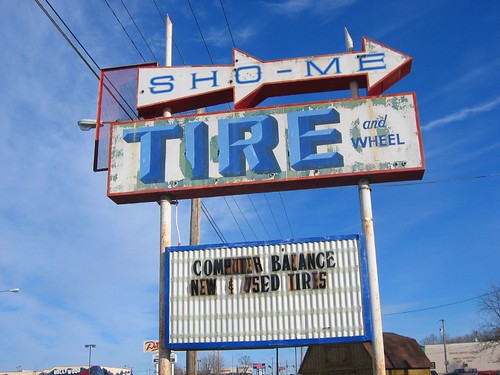
Missour-ah signage

Flickr photo


I was in Springfield, Missouri for work last week, and I was really surprised and impressed with the number of old, unique signs. Over on Flickr, you'll be amazed by two shots of some amazing Glo Laundromats signs, and a strip mall called "Country Club Plaza" that has an old orange sign with an analog clock on it. Good stuff.

Thursday, December 15, 2005

On the trail of the Meth Capital

Meth is known by many names -- speed, ice, crank, crystal, glass -- and, by many accounts, it continues to spread throughout the US. Whenever a conversation turns to the subject of meth, someone inevitably identifies some American city as Our Meth Capital. Others in the conversation usually disagree -- "Des Moines? I thought Fresno was the meth capital," "No, it's Gainesville, Florida," "I thought it was somewhere outside Phoenix," and so on.

Judging from the cities that are thrown around in these conversations, the meth capital should be (a) poor, (b) white, (c) somewhat small, but not unheard of, and (d) known for heavy industry, agriculture, or tourism. Of course, the Internet has something to say about the location of our meth capital. Most seem to agree that it's in California, probably somewhere in the Central Valley now that the tweakers have been run out of Riverside and San Diego counties.

Nominations for our nation's meth capital include:


  • The LA Weekly, California's Central Valley: "What Colombia is to cocaine, the Central Valley of California is to meth labs."

  • Sierra Magazine, California, Arizona, Missouri: "California, Arizona, and Missouri vie for the dubious honor of meth capital of America ... in terms of sheer volume, California has always been and remains Numero Uno."

  • Austin American-Statesman, Not Texas: "Should the bill not pass, Estes warned, 'we can count on Texas becoming the meth capital of the United States.'"

  • Missouri Senator Kit Bond: Missouri: "Unfortunately, Missouri is the methamphetamine capital of the United States."

  • The Southern Illinois Daily Egyptian, Missouri: "The concept is coming over from Missouri and is spreading across the area."

  • Slate, Everyone needs to chill: "Submit the search terms "methamphetamine capital of the world" or "meth capital of the world" into Nexis, and it spits back almost 70 citations between 1983 and 2005, with many writers and sources disputing the capital's precise GPS coordinates."

Tuesday, December 13, 2005

Art / Say it isn't so, Gocco.

Nooooo! Print Gocco, the ingenious, addictive Japanese home screen-printing press, is (apparently) being discontinued. Gocco supplies have been scarce lately (at Pearl Paints on Market, anyway), so I called Welsh Products. As I was ordering some bulbs and screens, I commented about the scarcity, and the woman on the other end said, "Well, they have discontinued it, you know."

[Sound of phone hitting floor]

She said that Riso would continue to manufacture ink, bulbs and screens for three years, but that they're ceasing production of the B6 press (the classic) very soon.

Immediately after I hung up, I verified the news on the Internet -- because it is so trustworthy in news of this nature -- and quickly found a site dedicated to the preservation of Gocco: Save Gocco. I couldn't find any official reference, but MAKE magazine seems to believe the hype as well. Gocco's US site doesn't mention anything about it.

Thursday, December 8, 2005

Dust it off / XTC, Skylarking

Skylarking
Here's my question: How did this become the "Dear God" album, considering at least half the songs on it are as good or better? Damn you, Sarah McLachlan. I hadn't listened to it since maybe 1995, when Ted and I played the shit out of it. We both loved the Beatles, and I had a fondness for the synthy 80's style. This album combines these qualities, and adds a little indie rock sensibility as well.

Now that the Cars and Hall & Oates have been on heavy hipster rotation for the past year or so, I'm surprised that XTC haven't seen some props, especially for this album. Compared to other XTC albums, the vocals are more blended with the rest of the sound, rather than held above it, which reduces the saccharine edge of later albums (Oranges & Lemons, for instance). Maybe XTC just doesn't have the kitschy cache of other 80's bands, who knows?

Incidentally, you can read more about the most well-known song on the album. Here's a fan of Sarah, explaining why it's okay to love Sarah even if she questions the existence of God: "I do not believe that you should rule out a whole singer or album just because of one song that you do not care for."

Wednesday, December 7, 2005

Dust it off / Sleater-Kinney, All Hands on the Bad One

All Hands on the Bad One, babyMost of my records, CDs and tapes sit idly in crates and on shelves, so here's what I'm going to do: Every so often, I'm going to dust one off and see what it sounds like. Dredge the archive, and take a good long listen to something I haven't heard in 2+ years.


Tonight, I begin the experiment with a randomly selected record: Sleater-Kinney's All Hands on the Bad One, which I'll admit I haven't listen to in three years. Maybe four.


Here's the thing about Sleater-Kinney and me. I'm probably one of the very few San Franciscans (of a certain age and neighborhood) who *likes* them but doesn't *love* them and sometimes wishes they would cool it with the too-often shrill vocals. But of course everyone knows they're politically-active feminists who play punk rock, so what's my problem?


Let's talk about Bad One. It's got great moments: the title track and "The Professional" are rockin and fun -- even after five years, they're a couple of the all-time great songs to listen to while riding a bike. The problem is that, for the most part, this album is huge step away from their early, raw sound, which had a lot less Heart-esque power ballad voice. Songs like "Milkshake n Honey," and "Ballad of a Ladyman" feature this voice, which for me is the element of their sound that rocks the least. (It comes down to this: If Carrie Brownstein harmonizes with Corin Tucker on a song, chances are that I'll like it).


I'll say something nice about them: I saw them move the crowd in a serious way at Dolores Park one summer. Their fans were freaking out, and the band itself was having fun and sounding good -- even songs I didn't like were pretty great. I really wish their albums captured this better. But like anything, their sound can't be all things for all people, and they seem to please some group of people everytime they put out an album, so more power to them.

Art / Robert Adams at SFMOMA

Flickr photo
I'd never heard of Robert Adams before I saw his show at SFMOMA. Called "Turning Back," the photos document the destruction of the old-growth forests that Lewis & Clark passed through on their journey westward. The title refers to the implications and complications of westward advancement. When Lewis and Clark reached the West Coast, they turned back and headed east; the vast devastation in Adams's photos conveys the sense that -- these days -- there's no turning back.

"Turning Back" is bound to strike a chord with people. It evokes indelible American ideals and icons -- the natural beauty of America, the promise inherent in the West, the bravery of Lewis & Clark -- and presents it in a format and style eerily reminscent to another photographer named Adams -- Ansel. Whereas Ansel's classic photos endeavor to communicate the vastness and beauty of America, the best of Robert's manage to convey an equally vast devastation.

While I walked through the show, I thought a lot about my hike on the PCT, which took me through a few of the same forests featured in the show. As I approached the northern part of the west coast, I was pretty curious about the clear cuts. Of course I knew that it would be depressing, but really I had no idea what to expect. I imagined a sort of Lorax-y landscape of smooth hills dotted with little stumps.

As I hiked through the vast clear cuts of Northern California, Oregon and Washington, I was stunned *not* by the absence of trees, but the obvious brutality surrounding their removal. In the newer clear-cut areas, there was upturned earth everywhere, huge mounds of soil, mangled stumps -- I've never been on a battlefield, but there's probably more a few similarities between the two. In some places, the dirt mounds and fallen trees completely obliterated the trail, and we had to do some pretty thorough route-finding before we made it through.

In the areas that had been clear-cut years before, the trees grew in thick clumps. One didn't so much hike through them as swim, or claw, or climb. The small trees were themselves fighting for space, and their branches were so densely interwoven that the ground was invisible for hundreds of yards around. In the mornings, before the dew evaporated, one could easily get soaked in the space of twenty yards while pushing through the branches.

Adams's photos convey the brutality and upheaval well, though I really wished that context had been provided along with each photo -- where was it taken? when? what used to be there? I wanted to connect with specifics of geography and fit the pieces together.