Tuesday, May 29, 2007

San Francisco / Maps and earthquake shacks

San Francisco in Maps: 1797 - 2006This weekend I got an incredible book about San Francisco called San Francisco in Maps & Views. I usually avoid glossy coffee-table historical books because they're so often filled with disappointments -- bad color, bad printing, messy layout, uninspired writing, PLUS they're really expensive. But THIS ONE. This one is different. The maps are very well-reproduced, high-res and colorful, and all are supported by detailed and surprisingly engaging commentary.

After I got over the initial thrill of using it like a flip-book and watching my neighborhood evolve, I started to notice smaller trends in land-use evolution -- a plot labeled "orphan asylum" became "hospital;" many things labeled "cemetary" became "park" or "civic center." "Dunes" become "the Sunset."

I was also intrigued by the use of public places as refugee camps after the big one hit in 1906. Apparently, SF carpenters sprang into action and built thousands of makeshift cottages for the earthquake/fire refugees, turning many well-known SF public spaces into refugee camps, including South Park, Dolores Park, and Precita Park, and lots of the then-outlying, undeveloped areas, like the Richmond and the Sunset.

Earthquake_shacks_in_Dolores_Park
A shack on Bikini Ridge would have been puh-retty sweet. (This is Dolores Park, believe it or not). Photo: Western Neighborhoods Project

As the city began to return to normal a year later, a few of the refugees decided to use the cottages -- or, "shacks" as they were commonly known -- as more permanent residences. Some industrious people combined multiple shacks into one residence. Incredibly, a few shacks are still around, and naturally folks have organized to preserve them. (Here's a 2002 Chronicle article about efforts to save some shacks in the outer Sunset).

Cumby_shack
I believe that this is the house that is listed as 300 Cumberland on the Western Neighborhood Project's list of known shacks. The crazy thing is that this is at the top of an insanely steep hill, like un-bike-ably steep and long, so it must have been built there rather than transported from Dolores Park. On the other hand, who knows? People were crafty back then, right?

Finally, here's a map of the locations of the known existing earthquake shacks. Seems like a good project for a weekend afternoon.

Google street-view meets new apartment

Mara and I just moved into the Lower Haight earlier this month, and Google just released a new Maps feature -- Street View -- that has a picture of our place. If I weren't writing about this, I'd be speechless. Wow.


Our new place on Fillmore
Our place is the yellow two-story walk-up that is bustin out of the top of the frame. I love that it was captured on one of those semi-sunny days where little wisps of fog drift through. So nice to not live in the fog belt. Incidentally, here's the Chronicle's fog forecast. Doesn't look good.


Street Level seems like useful functionality, esp. for fancy mobile devices, which I don't have. The controls are pretty straightforward and easy to use on a desktop, but I wonder about the ease with which one could navigate up and down the streets with those teeny arrows on a Palm or Blackberry. This is really nitpicky, but I think it would be effective to introduce more map navigation into the image, i.e. skipping to the next intersection, returning to the original destination, etc. Future-wise, it would be awesome to be able to do stuff with the images -- easily insert them into other things, string them together in connection with directions, etc.

What I want to know is: How the heck did they do it?

Thx, kottke.

Wednesday, May 23, 2007

Must-see movies / Killer of Sheep

Leaping boy from Killer of Sheep
A moment from a beautiful, riveting scene in Killer of Sheep. Photo: Milestone Films.

Killer of Sheep is director Charles Burnett's account of life in the LA neighborhood of Watts in the early 1970's. It began life as his senior thesis at UCLA film school and until recently it was never seen outside art houses and museums. Despite all of that, it was among the first 50 films to declared national treasures by the Library of Congress. I saw it earlier this week at the Castro, and it lived up the hype.

Burnett's account of his motivations in making the film seems like a good place to start unpacking the stuff that makes it so unique:

I wanted to tell a story about a man who was trying to hold on to some values that were constantly being eroded by other forces, by his plight in the community, and the quality of the job that he had. At the same time he wanted to do right by his family. I didn't want to impose my values on his situation. I just wanted to show his life. And I didn't want to resolve his situation by imposing artificial solutions like him becoming a doctor or a diplomat, when the reality is that most people don't get out. I wanted to show that there is a positive element to his life, and that is that he endures, he's accepted it. [From an excellent interview on Senses of Cinema]


To bring this story to life, he employs a style that seems improvisational, as much documentary as Italian neorealism. But there's also something very new and genuine and particularly American about it -- isolation, crumbling buildings, explosions of cruelty and anger, and the constant, chaotic motion of kids leaping across rooftops and crawling under buildings -- combined, these things seem to evoke a very American way of poor, urban life.

More than anything, the movie makes you wonder at its very improbability: How in the world did he make that? Did he actually plan those moments that seem genuinely serendipitous?

Maybe it's that the actors are untrained. The dialogue seems fresh, surprising and authentic even when it's forced. Maybe it's the pacing of the editing. Scenes start abruptly -- children emerge from a hole, an entire neighborhood has assembled in a stairwell, kids hide behind a scrap of plywood. Most scenes also tend to end a couple of seconds early, or linger a few seconds longer. Maybe it's the dialogue -- it's all mumbles or hollers or growls, with jazz and blues tracks adding rhythmic, sometimes hopeful counterpoints to the imagery. Who knows? What's clear is that it speaks in a true, clear and unique voice. Go see it.


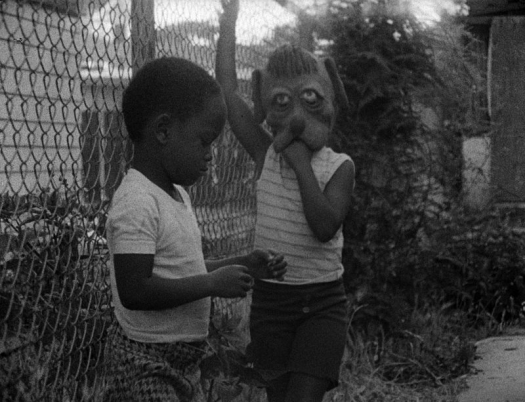
Dog face in Killer of Sheep
No dialogue. Dog mask. Chain link fence. Killer of Sheep. Photo: Milestone Films.

Weekend reading / Nuclear war, office drama

The Atomic Bazaar: The Rise of the Nuclear Poor

I came upon the work of journalist William Langweische in pre-Internet times, reading a faded and dog-eared photocopy of "The World In Its Extreme," a series of Atlantic Monthly articles that trace his travels across the Sahara desert. A vivid scene leaps to my whenever I'm in an airplane: He is on his way to a remote Sahara outpust, flying at a low altitude above the sweltering desert in a rickety old plane and surveying an endless expanse of what appears to be nothingness. I think of this as I pass over (my homeland) the Midwest. Like the Midwest, he finds that it's only mostly nothingness, that there are actual inhabitants and real-life oases, and his accounts of the people, places and cultures are really riveting. (He expanded this piece in a book called Sahara Unveiled).

Langewiesche's new book, The Atomic Bazaar, was the cover story of this week's NYT Book Review. I have no doubt that it will be great, even though the topic is one that I'd almost prefer to think about less: The circumstances under which a group of terrorists could acquire highly enriched uranium and then build a bomb. If you listen to these NPR interviews with him (part one; part two), you get the sense that it's a lot easier than it should be, but that the likelihood is still there. Now that the book is out there, I know I have to read it.

Joshua Ferris, Then We Came to the End
Then We Came to the End: A NovelEarly this week, I plowed through Then We Came to the End, the debut novel of Joshua Ferris. It's a book about office life at ad firm in the early 2000's, specifically about how the fat, happy days of the late 90's give way to the slow, scary days of the early 2000's. In a nutshell, reality crashes into the fairytale; normalcy is shattered; there are efforts to deny the inevitable; the inevitable happens; a new normalcy is eventually erected amidst the rubble. It's good, though: Lots of interesting, authentic characters, funny dialogue, a few geniunely moving moments.

Geeks will appreciate that the novel is written in first-person plural omniscient, meaning that the story is told from the point of view of "we," but the identity of the "I" behind the "we" is never established. It works, I think. After 50 pages or so, I thought to myself: "Is he really going to keep this up for the whole book?" But Ferris never gets cutesy with it, and it effectively evokes a very office-like sense of disassociation, of total incorporation into the whole, of membership in a group that has completely assimilated the identities of its constituents.

Tuesday, May 22, 2007

Rachell Sumpter / Ethereal, still, and strange

rachell_sumpter_argonauts
Rachell Sumpter, Argonauts. From her collection at the Richard Heller Gallery.

Her stuff reminds me of lots of other artists I like -- Evah Fan and some aspects of Julianna Bright, for two. Maybe it's something about the West Coast, but they're all simple and light at first glance, but also deeply still, and it's a stillness that reveals something surprising, impossible, or discomforting, but in an amusing way. Usually. Anyway, there's lots more Rachell Sumpter prints and stuff at Little Paper Planes, and some drawings, prints, watercolors and more from a 2006 show at Sixspace.

Thursday, May 17, 2007

Warriors / Drama, elevation, a posterization, terrible officiating

The Warriors playoff ride is over, the Jazz's ride will come to an end sometime in the next week or so, but Baron's dunk over Kirilenko will live on FOREVER. Let's just sit back and appreciate it for a minute. (It's much better live).


the rise-up
Baron elevates and elevates; he begins his leap before Kirilenko and is still going up as Kirilenko descends. Mind-bending. To his credit, Kirilenko said after the game that it was an awesome dunk and that "at least I got to be on the poster." Also to Kirilenko's credit, he didn't foul Baron; if anything, it was an offensive foul. More on the stupid NBA officiating later.


stomach shot
As impressive as the dunk itself was Baron's stomach flash after he landed. Not really sure where this came from. The elementary school playground? An And1 mixtape? Wherever it came from, it was a stroke of genius in that particular setting -- Friday night, Oakland Coliseum, Western Conference Semi-final blowout. You could practically feel the Bay Area elevate that moment.


the dust-off
Again, haven't seen this before, outside of a playground game in the Panhandle, but Stephen Jackson appeared to be dusting something off Baron's shoulders. The remains of the rim? Some magic dust from David Blaine?


Incidentally, the best picture of all was not taken off my TV, but by an AP photographer from the other end of the court. It captures Baron as he descends from the dunk.
I really did believe
Like everyone in the NBA universe has already said, the Warriors were hugely fun to watch this post-season, and it was sad to see them go. It would have been nice to see more scrappy, inspired Matt Barnes moments; more Stephen Jackson daggers; more Baron Davis PERIOD. I've always liked Baron, but this post-season he had it all working: his fast-break vision, his high-arcing three-point bombs, his cross-over, his ability to get in the lane and dish out to open shooters. (More of Baron's finest career moments on YouTube.) It was nice to see Monta get his game back in games 4 and 5, and Biedrins had some really strong moments, by which I mean some ridiculous dunks and a few improbable free throw conversions.

Yes, the Jazz deserved it
At the same time, I admired Utah by the end of the series. Jerry Sloan is an asshole, but he proved in this series that he is an asshole who knows what to do with talented players. The 3-D guard play (Deron Williams, Dee Brown and Derek Fisher) was unexpectedly solid and impressive. Memo and Boozer were SportsCenter fixtures throughout the season, but I was surprised at how easily Memo was taken out of his game by the quicker Warriors. I was similarly amazed at how great Boozer has become. The guy rose to the occasion, took lots of big shots, frequently changed the momentum of the game and was by any measure a badass among badasses. To say those things about a former Duke player requires a lot of pride-swallowing on my part.

In contrast to the uneven, streaky Warriors, every Jazz player was tenacious and gritty while exhibiting a professionalism and character that has been missing from the Western Conference playoffs this year. Why are so many players, especially Warriors, continually trying to draw charges? Play defense. Draw the charge when it comes to you, but don't try to substitute actual defense with stepping in front of a player as they go to the basket. Stephen Jackson! Dude! You were huge in the Dallas series, but against Utah you took yourself out of the game by trying to take charges and then getting pissed that the refs didn't call them! You know this: the refs are not going to give you those calls when the only thing you're doing is trying to draw them. Same goes for Barnes and Harrington.

UPDATE: Henry Abbott of TrueHoop has some thoughts on this very subject:

There are a lot of fouls called on players defending against the drive. What occurs to me more and more is that it's smart to do the whole "draw the charge" flop onto the butt, and only in part because you might draw the charge. A bigger reason is that if your hands are up, and you're jumping, and there's contact, you have NO chance of getting the call, and it's likely a foul on you.


An interesting point; perhaps it's all part of an effort to enable slashing and to complicate physical defensive play. On the other hand, superstars seem to get calls even if the defense seems to be legit. Baron obviously drew a lot of charges and hacks, which I think is evidence of a huger problem: THE F%@$$%$ING CONSPIRATORIAL OFFICIATING.

What the f%$#@%$?
It really seems like the referees go into each game with an agenda. Like, the Jazz got every call in game one. Why? Did they want to even things up from the previous series when it seemed like there were some quick whistles on Josh Howard? The lopsidedness of the calls make you wonder things like that. I mean, even Stephen Jackson had some legit beefs that night! Then in Game 5, Baron got pretty much every call. He literally ran over Deron Williams a couple of times, no whistles. When Williams would so much as touch him, whistle. Did the NBA want to prolong the series? Did they want to give Baron the superstar foul exemption?

UPDATE: And don't even get me started on the role of the NBA front office in all this. If the suspensions of Diaw and Stoudemire end up costing the Suns the series, I'm going to ... protest. Somehow. How can the NBA be so bad at interpreting their own rules? Every sport in the world functions effectively by implementing the spirit of its rules, not the letter. Why go by the letter in this case? Stoudemire and Diaw didn't escalate anything; they didn't incite further mayhem; what gives?

In spite of it all, great players make great playoffs. Thanks Warriors, and go Suns.

Thursday, May 10, 2007

Gamers / That's not even your blood

SI's Jack McCallum just published an article about the Suns-Spurs series that includes an intriguing peek into the mind of Robert Horry. As every NBA fan knows, Horry's blood runs cold during the playoffs, evidenced by his penchant for hitting dagger-like three-point bombs and his nickname, "Big Shot Rob." (NBA.com has a page dedicated to Horry's big shots, including commentary and video). But what's he really like?

McCallum's insight into this comes from the Game 1 collision between Steve Nash and Tony Parker.

An air of civility surrounded Game 1, an atmosphere that grew out of the mutual respect the franchises have for each other. There were Duncan and Suns veteran Kurt Thomas sumo wrestling for position down low, then patting each other on the back during a break in play. There was Nash, unaware that he was soon to suffer a TKO, bending down in concern as Parker lay on the court after their collision, a kinder response than Parker got from teammate Robert Horry, who said, "Get up, that's not even your blood."


Funny, that's exactly what I was thinking when I saw Parker writhing around. One thing is clear: Nash and Horry are both gamers.

[Thx, Henry]