Thursday, August 23, 2007

Summertime / Camping in the Winds

Flickr photo
When I start a camping trip, the Van Halen song "Panama" [Video on YouTube] often pops into my head -- I wish I could represent Eddie Van Halen's reverby guitar opening in words, but I was humming it and singing the chorus -- Pa-neh-ma ... Pa-neh-ma-ha -- as this picture was taken. That's the Wind River Range coming into view beyond my friend Nick. For the next 10 days, it would dominate us. In fact, this photo represents the last few moments of peaceful hiking. Our packs were really, really heavy, and soon enough the hurt would begin. Then, we would get rained on pretty often, and (for my part) suffer too many black fly bites and a few altitude-related headaches. Still, totally, totally worth it.


Flickr photo
I could go on and on here, but my pictures on Flickr really tell the story better than I can.


I'm a shameless sucker for gear, so here's some shout-outs:

  • Bridgedale socks. They were really wet, really often. But they stayed warm and they maintained some spring, even when soaked.

  • Tarptent. I visited Tarptent designer Henry Shires at his house on the Peninsula, and I bought the Squall [PDF] last spring. Since then, I've put it to the test in the Gila Wilderness, Yosemite, and the Yuba River. I was still skeptical about its ability to really keep me warm and dry, but I must testify that, even when it rains hard all afternoon (and even when the rain really comes down), the Tarptent abides. Everything people say is true: It's a really good, reasonably light backpacking shelter, and it's got everything you need to anchor and adjust it to respond to changing weather and wind.

  • Blistoban. Part of the reason for the shout-out to Bridgedale was that, halfway through, I switched to thinner Smartwool socks, and they absolutely killed my feet in the matter of a couple of hours. Nick loaned me some Blistoban strips, though, and they ruled. How does Blistoban compare to my old backpacking blister-control remedy: antibiotic ointment covered by bandaid which is then covered by duct tape which is then smeared with Vaseline? Jury's still out here.

  • Patagonia Dragonfly. They call it the Houdini now, and it's a little different, but I bought one of the early models in 2003, and it still impresses me. I wore it almost everyday, and it admirably repelled rain without ever becoming oppressively warm.


UX / Flickr pisses me off

My Flickr pageYes, I appreciate Flickr. After all, it allows me to store my photos online, share them with others, and display them on my website. Yay. Thanks for that. Still, it frustrates me daily. Here's why:

Sequence of photo display is set in stone
If I drag a dozen pictures into the Flickr Uploadr, God only knows the order in which they'll appear on the site. But I care about the order in which they appear on the site, because the LAST photo uploaded ends up being at the top of my Flickr homepage, and in that position of prominence it says something about me. It annoys me that I can't control this more.1
Little control over homepage layout; no way to make stuff sticky
So, if I can't control the order of uploading, can I control what's displayed on my Flickr page? No. Can I make a set sticky, so that it stays at the top of the list? No. Can I display only sets? No. Of course, Flickr has introduced new layouts, but all of them are simply ways of arranging the most recent stuff. Not helpful to me.
No concept of new-to-a-user
I'm thinking of my grandparents here. Wouldn't it be nice if a meta-set (or something) was created of stuff that's new to the viewer? I could just create a bookmark here, and they could check for new stuff.
Tagging is a royal nightmare.
Maybe no one has totally solved this yet, but here's something that would work for me: I usually upload multiple related pictures at a time, and these pictures tend to share a lot of the same tags. So I'd like to create small groups of tags for a groups of pictures, and then quickly drag and drop, or multi-select and apply, a tag to a subset of those pictures. del.icio.us's tagging interface is rudimentary, but it's vastly more helpful than Flickr's:
What del.icio.us does well in tagging


The navigation confuses everyone except geeks and experts
Collections? Sets? Archives? What's the diff? As my mom once asked me, "Where are the albums?" At the risk of sounding irretrievably old-school, this particular set of grouping concepts is a frustration to cognition. (Also, if the distinction is made in this navigation area, why aren't the things (sets) in the right column labeled as such?)
Flickr secondary nav


No record of blogged pictures?
When I create a blog entry from a picture, why isn't there some kind of record that the image has been blogged? A link? This just seems so basic to me.

1 Interesting side note: I bumped into some Flickr people at CHI, and I asked them about this. Their rationale: The photostream is what Flickr is all about, and the strictness of the sequence is a useful governing principle. Umm, yeah. Flickr people may think of uploading as a continual stream, but I upload photos in clumps -- I don't always think about my photos in the terms of the last photo uploaded, I often think in terms of the last group. I feel like I should have control over the way those clumps are displayed. If you force me to always show the most recently uploaded individual photo, shouldn't you also give me some control over the order of upload in your Uploadr?

Tuesday, August 21, 2007

Washington DC / Fortress of democracy

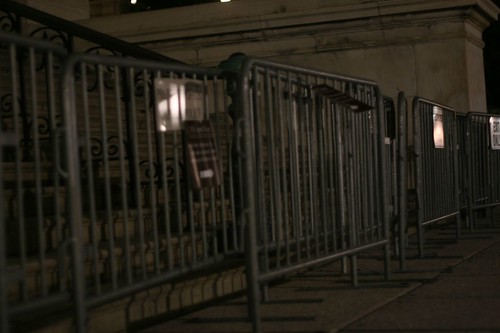
If the government buildings are any indication, Washington DC is a city bracing for something. Makeshift barriers surround the Capitol; men with automatic weapons stand watch over random governmental doorways and intersections. Sure, this is no different than other “significant” places in the Western world – London and Frankfurt have their share of fortresses and sentries – but as a citizen and idealist I’d hope that Washington would be different. I'd hope that *we* would do it differently.


Flickr photo
Our lawmaking buildings were designed to be approached: Sitting at the head of the Mall's long runway, the Capitol Building inspires further investigation. Nowadays, if a person (say, me) decides to take a picture of the fences around this beacon of democracy, that person may get reprimanded by a guy with a gun. I'm just saying: It happens.


Anyway, I hope that we'll search for solutions to the problem of security that don't run counter to the ideals of democracy: that lawmakers operate in the open, that anyone can see how it’s done (and indeed that everyone should see how it's done), that people are innocent until proven guilty, and that I'm paying for those fences, dammit, so I should be able to take a picture of them without getting harassed.

UPDATE: Even the new $50 bill emphasizes the approachability of the Capitol.


50 dollar billCheck out the little white figures climbing the steps on the left-hand side of the Capitol building. This seems to imply, to me, that people can (and should) walk up the stairs to see what's happening within the hallowed halls of democracy.


Adaptive Path UX Week / One of ux, one of ux1

I attended (and spoke at) my first UX Week last week in Washington DC, and it lived up to its billing as a good ol’ time. I met many amazing people, stayed out too late, and yet was still motivated to get up early every morning to see the keynotes. That’s saying something. Most conferences can be considered successes if just one of those things happens.

UX Week 2007 Program
The UX Week program with my lucky cat.


Breaking it down
The sessions came in three varieties: (1) products and interface implementations; (2) design tools and processes; and (3) ideas and inspirations. Sarah Nelson at Adaptive Path organized the conference, and she recruited speakers who were not the usual talking heads.2 The mix of backgrounds, experience, and subject matter kept things lively. I especially appreciated the discussions of process by AP folks like Indi Young, Kate Rutter, and Jesse James Garrett during the panel discussion of CNN.com. All of these opened my eyes to new design tools and techniques, and exposed the fact that there is a lot of innovation going on out there. In terms of the flashy products on display, I'm inherently too inquisitive and skeptical to believe what people tell me during product demoes -- I need to get immersed in them myself, and ask: How did you get there? Where did that come from? What need is that addressing? How did the design evolve? Because I'm a nerd.3

Design is story-telling
As Leisa Reichelt pointed out during our panel, a lot of speakers addressed the topic of story-telling in one way or another. Kevin Brooks of Motorola Labs led a workshop on storytelling techniques; the folks behind the recent redesign of CNN.com described the way in which they crafted the story that they told their internal stakeholders; people from BestBuy.com and Sachs discussed the use of videotaped customer stories to make a case for a redesign. Of course, story-telling and design are intimately intertwined -- two strands of a businessy double-helix. I was inspired by the variety of ways in which designers are telling stories about the problems to be solved, and the techniques and nuances involved in their approaches.

UX is real
I go to fewer conferences than I should (so I may be a bit sheltered), but I'll say this anyway: at the conference, I got the feeling that UX was much further along to becoming an actual profession. UX practices are no longer outposts in the Wild West of digital products; our work is now identifiable territory in the business landscape. Not long ago, there were very few things that wouldn’t be considered within the purview of user experience; now, the boundaries of our problems are a little more clear, and our experiences as practitioners have more commonalities than differences. I feel like Tom Hanks in Big.

Now, if only I could explain what I do to my parents ...

1 From one of my favorite movies of all-time, Freaks, i.e., one of us, one of us, we accept you, one of ux.
2 Okay, except Jared Spool, but it's always good to hear what he's thinking.
3 I admit: The interface for One Laptop Per Child is elegant and intriguing, but I'm politically ambivalent about the project itself. I'm fascinated by the possibilities of creating an information pipeline the developing world, but I guess I'm not enough of a tech evangelist to believe in the idea that distributing laptops is better than distributing more immediate aid. Maybe I'm not thinking big enough.

Monday, August 20, 2007

756 / I was there

I’ve said it before: I don’t like Barry Bonds. So it may seem strange that I wanted to be there when he hit home run number 756. But consider this: I love baseball; the record for career home runs is, like it or not, one of baseball’s hallowed milestones; Bonds plays in my city; the Giants were beginning a home stand as he was poised to break the record. Too many stars were aligned for me to NOT try to get into a game. I could always boo, right?

So, on Tuesday, August 7, I rode my bike to AT&T Park, hoping to get lucky and figuring that I wouldn't. Immediately, I got really lucky, scoring an amazing ticket in the club level (a $70 value) for the price of two AT&T Park beers. At that moment, I had a good feeling. A couple of hours later, Bonds faced a 3-2 count, and I decided to join 45,000+ other fans in pointing my digital camera at the plate. Up to that point, I made sarcastic remarks about mediating the experience in that way. Now I’m posting my crappy version on the Internet. Why? I don’t know. Anyway, a moment later, Bonds drilled the pitch into deep, deep center field and the stranger next to me grabbed my arm and started jumping up and down.


Here's the video that I shot with my digital camera. (Warning: It's bad. And bouncy).

For the next five minutes, I high-fived a lot of people, and someone gave me a hug as I was filming the celebrations. Fireworks exploded over McCovey Cove; streamers rained down; the Nationals left the field; Hank Aaron congratulated Bonds asynchronously through a pre-recorded video. It was surreal, but festive and exciting.

Of course, there was also a weird vibe. People seemed to feel personally gratified that they got to witness history, but few seemed really, truly happy for Bonds. Few people said: “Wow, good for Bonds.” Those who did were either people who possessed amazing capacities for forgiveness and seemed genuinely happy, or younger guys with way too much bitterness who saw Bonds as a kindred spirit. The rest of us said: “Wow. I can’t believe I saw that. Wow. This is really weird.”

After hitting the home run, Bonds left the game. It was the 5th inning, and the Giants had a 5-4 lead; the Nationals came back and won. My question: Who does that? Hank Aaron? No. Dimaggio? Never. Ted Williams? God no. Sort of a perfect ending to a conflicted, surreal night.