Wednesday, September 26, 2007

Lit / No room for anything but the old verities

The NYT book blog Paper Cuts recently published a nice entry about William Faulkner's late-in-life visit to West Point. It reminded me of one of my favorite moments from the (apparently out-of-print) Faulkner Reader: his acceptance speech for the 1949 Nobel Prize.

Reading it again this afternoon, this portion of his speech seems especially timely and eerie ...


Our tragedy today is a general and universal physical fear so long sustained by now that we can even bear it. There are no longer problems of the spirit. There is only the question: When will I be blown up? Because of this, the young man or woman writing today has forgotten the problems of the human heart in conflict with itself which alone can make good writing because only that is worth writing about, worth the agony and the sweat.

He must learn them again. He must teach himself that the basest of all things is to be afraid; and, teaching himself that, forget it forever, leaving no room in his workshop for anything but the old verities and truths of the heart, the old universal truths lacking which any story is ephemeral and doomed - love and honor and pity and pride and compassion and sacrifice.


The rest is here, on the Nobel Prize site. You can also listen to Faulkner's speech from the Nobel archives [requires Real Player].

Owl - Lantern in grass
A few weeks ago, I subscribed to an arty Portland blog called Urban Honking. Every couple of days, a photographer who goes by the name of "Owl" posts a few quiet, dark photos. This is one of them. As with Faulkner, I'm both jealous and inspired. Check out more Owl photos; it's totally worth it.

Tuesday, September 18, 2007

100 Northern California Hiking Trails

I stumbled upon a treasure trove of old outdoors books at Iconoclast Books in Ketchum, Idaho this weekend; this one's from 1970.

100 Hiking Trails - Cover
The cover ultimately doesn't make much difference, but I like this one.


100 Hiking Trails - Section
If only hiking through sun cups like these was as serene and lovely as the photo implies. Also, the introductory text instructs Yosemite visitors, "DO NOT FEED, TEASE OR MOLEST THE BEARS." Noted.


100 Hiking Trails - Trail
The page layout is classy, and the book is simple to navigate -- each set of facing pages describes one hike. Also, the map is intended as a thumbnail overview, not as the actual guide for use during the hike. (In 1970, maps could be acquired by sending $0.50 to the USGS.)


100 Hiking Trails - Detail
How do you know which map to purchase from the USGS for $0.50? The relevant USGS map ID information is in the top left corner of each page! Each hike has a summary that contains all the important stuff -- distance, elevation change, estimated time, and so on, ordered from most broad (and important) to most specific.


Wednesday, September 12, 2007

Baseball cards / 1960 Topps

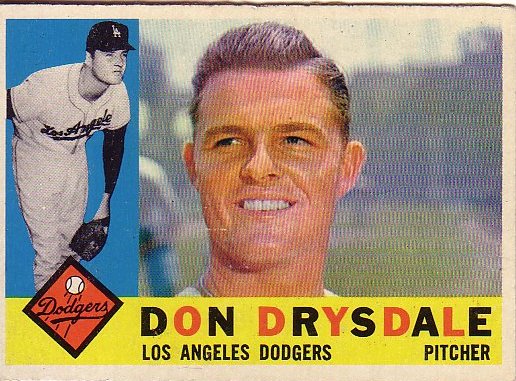
Like lots of stuff, they really don't make baseball cards like they used to. Halftone action thumbnail! Alternating colors in the player names! Don Drysdale's coif!
1960 Topps - Don Drysdale
1960 Topps - Curt Flood 1960 Topps - Elston Howard 1960 Topps - Don Larsen

Thursday, September 6, 2007

Clare Rojas at Gallery Paule Anglim

Lots of intriguing stuff at Clare Rojas's opening at Gallery Paule Anglim tonight. Woodland creatures, naked dudes in tai chi poses, an excellent video of Peggy Honeywell playing a slow sad song at a raging frat party filled with beer bongs and keg stands, Amaze, Barry McGee, and much, much more. Worth it.

Clare Rojas - It's hard out there for a penguin
I call this one "It's Hard Out Here For a Penguin."

Clare Rojas - Untitleable
I think this one is untitled, but it should be called "Untitleable."


Gallery Paule Anglim is at 14 Geary in downtown San Francisco.

Wednesday, September 5, 2007

Literary blogs / Paper Cuts

Cormac McCarthy adI've spent a lot time combing through the archives of Paper Cuts, the blog of the New York Times Book Review editor Dwight Garner. It steers clear of smartypantsness, focusing on what one might call the lighter side of serious literature. In fact, most of the content is on the periphery of the strictly literary -- a music playlist assembled by Miranda July, a quick, fun interview with Judy Blume, a scan of Jack Kerouac's obituary ("his subject was himself and his method was to write as spontaneously as possible"), a scan of an ad for Ralph Ginzburg's literary supernova Avant Garde that looks like the label on a Dr. Bronner's soap bottle.

Garner also has a podcast in which he interviews authors and reviewers from current and upcoming Book Reviews. Every once in a while, you'll suffer through some crap (e.g., Frank Rich gushing and giggling while furtively and unsuccessfully trying to hide the king-size man-crush he has on Don DeLillo). That said, most of the podcasts are informative and interesting.

The image at right is from a slide show of advertisements that appeared during the "golden age" of the NYT Book Review -- 1962-1973.

Foto / Modernity in Central Europe

Foto - Modernity in Central Europe
When I was in Washington DC last month, I saw an incredible show at the National Gallery called Foto: Modernity in Central Europe 1918-1945. As you may have guessed by the title, the show is photography-oriented, but it's more than that: It's a story about photography craft, and the way that European photographers bent, broke and otherwise manipulated photos to express the social, political and cultural fragmentation (and chaos) in the wake of the First World War. Most of the artists were unknown to me; they're all introduced and discussed in detail in the excellent exhibition catalogue. It opens at the Guggenheim New York in October.

Birth of a robot
This is a photomontage by a Polish artist named Janusz Maria Brzeski. It's called Twentieth-Century Idyll, but the name of the series is even better: A Robot Is Born. Photo: National Gallery of Art.

Jindrich Styrsky - Souvenir
Another photomontage, this one by Jindrich Strysky, a Czech artist. Photo: National Gallery of Art


Tuesday, September 4, 2007

Cuban cashola

Flickr photo
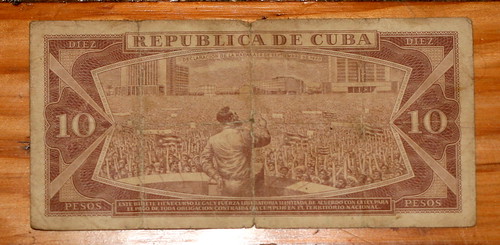
Fidel doing what he does best: Moving the crowd.


I traveled to Cuba 10 years ago this summer, and I unearthed this 10-peso note when I moved earlier this summer. Coincidence, or a sign that I should return sometime soon?

When I was there, the official exchange rate was one American dollar to one Cuban peso, but one could get 20 Cuban pesos with one American dollar if one exchanged money on the street. It appears that this hasn't changed, though Wikipedia notes that Cuban pesos have no value in currency markets.

When I was there, Cuba was still reeling from the collapse of the USSR, and accommodations were made to handle the hardships known of this Special Period. For example, the American dollar could be used to purchase "luxury goods," though at that point "luxury" involved eating chicken once in a while and drinking an occasional beer. They've since introduced a second currency to replace the American dollar, the convertible peso, while keeping two tiers of goods. Yanqui go home!

Just Expect To Be Left Utterly Enraged

Flickr photo
My cozy bed between Herman Miller chairs at Dulles.


News flash: Air travel really sucks right now (Washington Post). A couple of weeks ago, I too was touched by this national nightmare. On a Friday evening, I planned to fly from Dulles to SFO, but got slapped with an SSSS on my boarding pass (expired driver's license) and a long security line and figured I would miss my flight. Good thing it was delayed. For three hours, initially. The gate agents reported that there was bad weather in New York, and this seemed reasonable to me because there were lots of people at the other gates who appeared to be pissed off and tired. Also, the storm was all over the hundreds of TVs that blast CNN at you. I got comfortable and watched an excellent movie (Kurosawa's The Bad Sleep Well) on my computer, fully believing what the gate agents were saying: The flight would not be canceled. They emphasized this: It would not be canceled.

After two more delays, at 2:30am, the gate agents delivered the obvious: The flight would be canceled. Within milliseconds, an entire plane-load of people freaked out, fumed, growled, shouted insults and then scrambled to get re-booked. Lines at the desks: 45 minutes. Hold time on the phone: 45 minutes. Likelihood of getting out of DC in the next 24 hours: Zero. Compensation for our trouble: Zero. Our flight appeared to be the only suckers left at Dulles, but of course the airline blamed the cancellation on acts of God and air traffic control and, on those grounds, they refused to give us even a voucher for a soda. (A recent Washington Post article examines traditional airline excuses).

But wait, there's good news: The current issue of Popular Mechanics has an article about the FAA's work on a GPS-based air traffic control system, which will be up and running by ... 2025. Ugh.

I won't name the airline (because I am a gentleman), but I encourage you to look for clues in the title of this post. (Specifically in the first letter of each word. Thx, Khoi Vinh for the inspiration.)