Thursday, December 7, 2006

Design / The Beatles & collaboration

A lot of collaborative work goes on at Cooper (where I work). Designers team up to understand a problem, or to envision a better way of solving it. Sometimes, we collaborate with clients to figure out what's possible and where possibility and desirability meet. In any case, it's hard to trace back any particular idea to a particular person or moment; once an idea is out in the world, it gets pushed, pulled, disassembled, reassembled, and so on by everyone until it fits.

My friends and I used to argue over which Beatle wrote a particular song -- John? Paul? George? In most cases, it seems pretty clear cut. Cheesy lyrics and a bouncy rhythm? Paul. More complicated, layered lyrics with more straight-ahead rock? John. A sitar in the background? George. In some cases, however, it's much less clear. "With A Little Help From My Friends," for instance; or, "Got To Get You Into My Life." Both have recognizable earmarks of John and Paul.

Are these easy categorizations valid in any way? Is there any way of ultimately knowing who wrote what? I didn't think so. Until I Googled "beatles songwriting" and found The Beatles Songwriting and Recording Database, an obsessively categorized collection quotes about who wrote what, pulled from various interviews conducted over the last 40 years.

For example:

With A Little Help From My Friends

JOHN 1970: "Paul had the line about 'a little help from my friends.' He had some kind of structure for it, and we wrote it pretty well fifty-fifty from his original idea."

JOHN 1980: "That's Paul, with a little help from me. 'What do you see when you turn out the light/ I can't tell you but I know it's mine' is mine."

PAUL circa-1994: "This was written out at John's house in Weybridge for Ringo... I think that was probably the best of our songs that we wrote for Ringo actually. I remember giggling with John as we wrote the lines, 'What do you see when you turn out the light/ I can't tell you but I know it's mine.' It could have been him playing with his willie under the covers, or it could have been taken on a deeper level. This is what it meant but it was a nice way to say it-- a very non-specific way to say it. I always liked that."


Especially intriguing: John wrote "And Your Bird Can Sing," which (to me) seems to be the most obvious Paul song ever. Perhaps those earmarks I discussed earlier are less applicable than one would expect.

Wednesday, December 6, 2006

Thanksgiving remix

Flickr photo
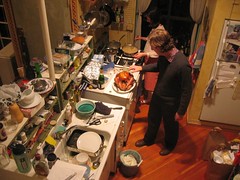
Thanksgiving 2006 came and went, attended by friends, family and the customary dramas.

An East Coast / West Coast feud flared up in the week before the holiday. Gabriel (East) sent what some in the West perceived as "a salvo across the bow" in the form of a PowerPoint presentation (a slide of which is pictured below). It contained a financial-style analysis of Thanksgiving: how Thanksgiving East has performed over the past decade, trends, projections, and outlines for future growth.

Some saw this as evidence of a diabolical plan; I was naive and asked for clarification on specifics:

Dear Gabe, TYs (Thanksgiving years) 2003-2004 were characterized by broad guest sector diversification. What is the likelihood that a diversified strategy, with exposure to the Shanahan sector, for example, will be pursued in the future? Secondly, to what extent will "value" guests (e.g., McClorys and Preslers) continue to anchor the portfolio? Will you pursue more (potentially) volatile "growth" guests in order to boost performance in the coming years?


Gabe replied:

Gabe's projection infographic
Like other mission-related offerings, we believe that diversification is important for ensuring steady, dependable performance in any environment to protect against sector-specific risk. But our commitment to diversification goes beyond our concern for the bottom line: indeed, we believe that it reflects our group's core mission. We are convinved that when we serve a broad range of attendants and when our offerings range across the geographic and social spectrum, our Thanksgiving is ultimately stronger.

I want to emphasize that we consider all of our participants "core" candidates. Alas, our commitment to value--illustrated by our proven track record of offering Thanksgiving at a deep discount to its intrinsic value--means that we are not always able to serve as broad a constituency as we would like. For example, many of our sought-after participants fall outside of our geographic universe; we are particularly interested in opportunities in California.


Needless to say, this kind of talk elicited skepticism and cries of regional pride among the West Coasters, feelings which became even more acute when additional news arrived: The East Coast guest list had grown so large, so ginormous, that the hosts scrambled to find larger accommodations for their dinner.

Now [East Coast Thankgiving] reports that their 2006 expansion plan has been so successful that they're relocating to a BAR for their festivities. clearly the bar has been raised. are we going to let presler corp. outdo us at what we do best? we have to rally around the turkey and show the east coast who rules this holiday.


Would cooler heads prevail? Some West Coasters called for "focus."

i hate to say it, but this whole thing reeks of a ploy to take us off our game. start chasing the presler-yamadas with this whole thanksgiving at the bar thing, and next thing you know you'll be doing blow off some stranger's anatomy at 5am while realizing that you forgot to even *buy* a turkey. we have to stick to what got us here. the fundamentals and an easy-going attitude that there's no reason to get stressed out because our moms are at least like a thousand miles away ... focus, people.


Laying on of handsOf course, Thanksgivings of yore were characterized by spontanaeity that often resembled chaos. (See right. More here.). To this end, there were appeals to pull together:

If Robert Altman taught us anything it's that great works of art are NOT created with scripts, business plans or PowerPoint presentations. We will honor his tradition and follow our usual free-flowing, improvised pattern. We will create a richly layered Thanksgiving that will touch on all of the major themes of modern life in a heartbreaking, at times comical, at times violent, but always incisive way. Like Altman, we are not afraid of failure. However, it's also true that some great works of art were created with blow (John Belushi, the DeLorean, Dwight Gooden) ...


In the end, there was focus and togetherness on the West Coast, and, by all accounts, steady growth with dividends in the East. A wise man once said: "Let love rule." It shall.

NYT / JFK to Manhattan on foot

“People don’t know where they are anymore, “ [the writer Will Self] said, adding: “In the post-industrial age, [walking] is the only form of real exploration left. Anyone can go and see the Ituri pygmy, but how many people have walked all the way from the airport to the city?”


This is from A Literary Visitor Strolls in From the Airport, a New York Times account of writer Will Self's walk from JFK to his hotel in Manhattan. Self walks 20 miles through a colorful cross-section of Queens, taking photos and chatting about his philosophy of perambulation. Cars (and TVs and computers and so on) have imposed a "windscreen-based virtuality," he says, effectively cutting us off from the landscape around us. The NYT writer name-checks psychogeography in connection with this discussion, but doesn't elaborate. Apparently, psychogeography is a common, everyday concept in which everyone is conversant. (I would guess that it's not). Also discussed: Self's seat-of-the-pants route-planning (he relied upon native New Yorker Rick Moody), and his experiences in the less-traveled parts of the borough:


Not long after negotiating the Cross Bay Parkway overpass, Mr. Self decided to go “off piste,” as he put it, borrowing the term used to describe [the act of leaving] groomed ski runs [to explore wild terrain]. He ignored Mr. Moody’s instructions and headed straight west on Glenmore Avenue, through East New York and Brownsville. Glenmore at this point slices through a long, grim stretch of low-rise apartments, pocket-size auto-body shops, razor-wired vacant lots harboring high-strung dogs, and a surprising number of churches, including one, Glenmore Avenue Presbyterian, that featured a Sunday-morning “Apocalipsis” service.

“What could be more suitable?” said Mr. Self, who had just been discussing the apocalyptic theme in his own novel and those of H. G. Wells.


A related personal account: Once, in the fall of 1997, my flight had arrived late to JFK, and I was racing to catch the last Delta commuter flight to Boston, which was leaving from a different terminal. When I arrived at the curb, the security guard told me that the shuttle bus had just left, and that I'd probably miss my flight. He mentioned that the terminal was "just beyond that big TWA hanger over there," and I thanked him and set off walking. Needless to say, there weren't sidewalks connecting the two, and I spent much of my time "off piste," scurrying along the shoulders of frontage roads and across parking lots. It was scary and fun, with planes periodically screeching just overheard, but I arrived just in time, and since then I've always wanted a chance to do it again.

Wednesday, November 29, 2006

Music / Sad anniverary for the quiet Beatle

Today is the fifth anniversary of George Harrison's death, as I found out when NPR ran a sweet tribute to him this evening. Back when such things mattered, George was my favorite Beatle. Why do such things not matter anymore? I mean, really, is there any question that is more revealing than "Who is your favorite Beatle?" Sure, it's dated, but any rational, music-aware person should have one, and if they don't, well, that says a lot right there.

Here's a cheat sheet for what you can expect from the people you ask, based on very unscientific "research" ...

  • If they say "Paul," you can expect some (mostly superficial) charm, and a liberal helping of cheesiness. People who like Paul tend to see Sgt. Pepper as the height of Beatle achievement, and they probably enjoy "Yellow Submarine" and "story songs" about Beatles characters like Eleanor Rigby more than "While My Guitar Gently Weeps" or "Norwegian Wood."

  • If they say "John," you can expect seriousness, outward lefty politics, a love of "meaningful" songs, and perhaps a disdain for both cheesiness and Paul. People who like John, I would guess, simply didn't like Paul to begin with, or liked him until they heard "When I'm 64" one too many times, and then dug around to see who wrote the lyrics to "A Day in the Life."

  • No one ever says "Ringo" in this day and age, and that's too bad. He's charming, a good sport, and (I think) not as bad a drummer as people seem to remember. I challenge you: Listen to "Rain" and tell me that Ringo is an insufferably bad drummer.

  • George, finally, will always be the favorite of people who you want to know. He represents humility, first of all. He's never mugging in the movies, and mostly he looks somewhat like you or I would look if we were thrown into the Beatles commercial juggernaut in the early 60's. On the creativity side, he wasn't Lennon/McCartney, but his guitar sound was an integral part of the Beatles appeal. It's always tasteful, and he never tries to get all Eric Clapton on any song, which is why I -- for one -- can listen to roughly 50 Beatles songs for every Eric Clapton song. Finally, George's solo stuff was way better than either Paul's or John's, and his low profile is endearing in a world in which the faces of rock stars' are perpetually up in your grill.


Beatles, Taxman -- from Alternate Revolver
[audio:http://www.douglemoine.com/files/beatles-taxman-mono.mp3]
Lately, I've been listening to Alternate Revolver, a bootleg album of demoes from the Revolver sessions. George's first contribution to the Beatles' catalogue -- "Taxman" -- is on Revolver; it's not my favorite Beatles song, but it's a little more straightforward and rockin' than later George songs. Is it contradictory to commemorate an artist by listening to a pirated version of his/her work? Hmm. I'll venture a guess that George would appreciate it, so check out Alternate Revolver's mono mix of the song, and toast the quiet Beatle.

Art / Robert Irwin, BS, and the importance of questions

Flickr photo

My nomination for All-Time Best Moment In An Art Documentary has to be the "Bullshit!" scene in Concert Of Wills: Making The Getty Center. Abstract-artist-turned-landscape-designer Robert Irwin literally calls bullshit on architect Richard Meier during an important Getty Center planning session. [The object of their disagreement is Irwin's garden design, pictured at right. Thx, brewbooks.]

Design Observer's Michael Bierut sums it up nicely in an article called "On (Design) Bullshit:"

The [Getty Foundation], against Meier's advice, has brought in artist Robert Irwin to create the Center's central garden. The filmmakers are there to record the unveiling of Irwin's proposal, and Meier's distaste is evident. The artist's bias for whimsical organic forms, his disregard for the architecture's rigorous orthonography, and perhaps even his Detroit Tigers baseball hat all rub Richard Meier the wrong way, and he and his team of architects begin a reasoned, strongly-felt critique of the proposed plan. Irwin, sensing (correctly, as it turns out) that he has the client in his pocket, listens patiently and then says, "You want my response?"

His response is the worst accusation you can lodge against a designer: "Bullshit."


If I recall correctly, Meier is speechless, and the mood of the documentary shifts quite significantly. Meier's personality and viewpoint had dominated (is "domineered" a word?) earlier scenes, he maintains a sort of icy distance in subsequent scenes. (Disclosure: While I respect Meier, I'm not a fan of his work, especially the Getty, and the documentary makes clear that he is, umm, a dick). Irwin, on the other hand, I've always loved, especially his dot paintings. I'm currently reading Lawrence Weschsler's biography of Irwin, Seeing Is Forgetting the Name of the Thing One Sees, and it contains some useful background and context to the "Bullshit!" scene. It also complicates it; the more I read, the more Irwin and Meier seem to have quite a lot in common. I'd always assumed that Irwin's vision was the irrational, organic counterpoint to Meier's rational, geometric forms. The book makes clear that Irwin has quite a lot of the rational geometry on the brain himself. Perhaps they were just too similar to get along.

A large portion of the book is dedicated to Irwin's discussion of his own process ... My favorite passage involves Irwin's explanations of the fits and starts that characterized his output, especially during the dot painting phase:

"Most of the time, I didn't have any idea where it was going; I had no intellectual clarity as to what it was I thought I was doing ... Maybe I was just gradually developing a trust in the act itself, that somehow, if it were pursued legitimately, the questions it would raise would be legitimate and the answers would have to exist somewhere, would be worth pursuing, and would be of consequence.

"Actually, during those years in the midsixties," he doubled back on his formulation, "the answers seemed to matter less and less: I was becoming much more of a question person than an answer person ... The thing that really struck me as I got into developing my interest in the area of questions," Irwin continued, "is the degree to which as a culture we are geared for just the opposite. We are past-minded, in the sense that all of our systems of measure are developed and in a sense dependent upon a kind of physical resolution. We tag our renaissances at the highest level of performance, whereas it's fairly clear to me that once the question is raised, the performance is somewhat inevitable, almost just a mopping-up operation, merely a matter of time."

Friday, November 17, 2006

Kansas basketball / Jitters, a jinx, and a stinging loss

Question: What happens when a young college basketball team without a proven low-post presence somehow manages to secure a high national ranking then faces a really hungry, experienced team? The Hawks found out two nights ago, getting their rear-ends tanned by an unheralded and obviously hungry Oral Roberts team.

Where does this rank among the hardest-to-swallow losses in recent memory? I don't want to go overboard here; it's not as crushing as the two NCAA Tournament early exits. It also wasn't as demoralizing as losing to K-State (at home) and Missouri (after leading by 7 with a little over a minute left) last year. It's most reminscent of the 2004 home loss to Richmond, when the entire sporting nation could turn on ESPN to see the Hawks implode on their home floor to a team that wasn't even playing that well. ESPN didn't carry the ORU game on Wednesday night, THANK GOD, but the loss rippled through the sports press in a way that always seemed to emphasize the Hawks simply failed to look, umm, good. SI said simply: "Oral Roberts outplayed No. 3 Kansas the whole way."

Question: How in the world does SI rank KU above a team like Florida, the defending national champions who returned every starter from last year? Did they want to avoid jinxing Florida for some reason? (SI added KU to its list of cover jinxes). Maybe they settled on this arrangement before Sasha Kaun got hurt, and before CJ Giles pulled a Lawrence Phillips and got himself kicked off the team?[1] Even so, how does any front line arrangement compete with Gator paint-dominators Al Horford and Joakim Noah? We'll find out soon enough, I guess, since the teams will meet a week from tomorrow in Vegas. Gulp.

[1] Wikipedia's abstract on Lawrence Phillips: "Lawrence Phillips (b. May 12, 1975 in Little Rock, Arkansas), is a former professional American football and Canadian football running back who has had numerous conflicts with law enforcement." Sorta says it all.

Tuesday, November 14, 2006

Art / Olafur Eliasson in the New Yorker

Two winters ago, I traveled to London for work. It was cold as hell, as a witch's tit, as the blood that runs in Dwyane Wade's veins during the fourth quarter. The sky was deep gray, hard, heavy and forbidding, and it felt as if it wasn't more than 10 or 12 feet above my head, ready to come crashing down at any moment.
One afternoon, in a jet-lagged haze, I wandered over to the Tate Modern, where it seems they always have some thought-provoking installation (for instance, Anish Kapoor's gigantic levitating horn which blew my mind for a while), and as I descended the ramp into the museum, I was struck by the absolute inversion of wintry, outdoor London. I took lots of photos, but none could really communicate the immersive aspect of Olafur Eliasson's work, called "The Weather Project." It was all reds and oranges, all warmth and mist, enveloping you in a happy, gauzy glow. Cynthia Zarin recently profiled Eliasson for the New Yorker, and she comments that the Weather Project cemented Eliasson's reputation in the art world ... (Unfortunately, I can't find a link to the article online, but by all means dig through back issues of the magazine at the laundromat, if you get a chance. The article provides interesting insight into Eliasson's process, and includes some funny anecdotes relating to his impulse to immerse the viewer in an environment. For instance, in mid-long-distance-phone-conversation with Cynthia Zarin, he places his cell phone on the luggage conveyer belt at the airport, lets it go around the carousel once, then picks it up and asks her what the experience was like. Hmm.).

Saturday, November 11, 2006

Architecture / Front porches, refuge and prospect

Last summer, NPR did a series on one of my favorite architectural elements -- the front porch. An installment from late July covered the use of the porch in contemporary home-building, specifically in New Urbanist (wikipedia entry) developments, such as Seaside, Florida and other pseudo-quaint "towns". (More on my problems with New Urbanism another time).

The most intriguing part of the show, for me, was an allusion to the psychology of the home, and the fact that a large part of recent home-building has focused on the home as a fortress, a defensible space, rather than a vantage from which to observe and interact with the world. This was my introduction to the prospect-refuge concept; prospect representing the ability to survey the surrounding landscape, and refuge serving as a hideaway from the world. It's simplistic, but I like it and I believe it, insofar as I can believe any theoretical concept can describe the fundamental needs of everyday life. Universal Principles of Design has a good overview, with lots of interesting related material as well.

Tuesday, October 24, 2006

Lit / Fall reading list

Flickr photo


Somehow a recent NYT Book Review convinced me that I needed to read this season's hott new thing, Special Topics in Calamity Physics by a much-blogged-about literary debutante, Marisha Pessl. It's no Secret History, if that's what you're looking for. It's not bad, but on the other hand it's not especially delicious, nor smart, nor scary. It also contains a few drawings done by the author, none of which are very interesting; the drawings are randomly scattered, not especially revealing, and actually in these regards, they sum up my ambivalence about the book.

Also on the list: Nothing If Not Critical, a collection of art criticism by Time critic Robert Hughes. In general, I dislike "criticism" as a genre because it so frequently comes across as insulated from, I guess, reality. The very few successful critics succeed because their writing exposes the object of criticism to new light, a fresh perspective -- and the list is short: Lester Bangs and Robert Hughes, maybe Anthony Lane. Hughes's review of Julian Schnabel's autobiography made me laugh out loud, repeatedly, even as I awaited a dentist appointment: "Schnabel is to painting what Stallone is to acting -- a lurching display of oily pectorals -- except that Schnabel makes bigger public claims for himself." Ziing! Now that's criticism! In 2003, the UK's Guardian published an interesting bit on Schnabel's endeavors to resurrect his career.

Post Office by Charles Bukowski is both better and worse than I remembered it. I read it in my early 20's, a time when I could identify (or thought I could, anyway) with being down and out, so I admired the cranky tone, the disdain for the "straight" world and all the "suckers" who buy into it. Nowadays, I would probably qualify as a sucker, and I can confirm that the straight world really is as boring and soul-crushing as Bukowski presents it. As I was reading it, I kept thinking: What would Bukowski do in my situation? At the very least, he would stash a bottle of booze in his desk. And probably duck out for a stiff drink or two in between meetings.

Finally, the best of the lot is Eric Newby's (mis)adventure classic A Short Walk in the Hindu Kush. What happens when two refined British gentlemen with no moutaineering experience decide (on a lark) to climb an 18,000-foot mountain in Nuristan, a warlord-controlled region of Afghanistan? The book chronicles this mid-1950's boondoggle, including Newby's means of traveling to Afghanistan -- an automotive journey through Europe and the Middle East. [A sad note: Newby recently passed away. The BBC obit.]

Wednesday, September 13, 2006

Lit / Philip K Dick on building universes

In 1978, Philip K Dick published an essay called "How to Build a Universe That Doesn't Fall Apart Two Days Later." The title sort of says it all; it's about how to envision the world of a story in a way that lasts. He cuts right to chase, too, confronting the hard question that most writing how-to's like to gloss over: What is worth writing about? Where to start? How to make a statement that doesn't age badly?

... I ask, in my writing, What is real? Because unceasingly we are bombarded with pseudo-realities manufactured by very sophisticated people using very sophisticated electronic mechanisms. I do not distrust their motives; I distrust their power. They have a lot of it. And it is an astonishing power: that of creating whole universes, universes of the mind. I ought to know. I do the same thing. It is my job to create universes, as the basis of one novel after another. And I have to build them in such a way that they do not fall apart two days later. Or at least that is what my editors hope. However, I will reveal a secret to you: I like to build universes which do fall apart. I like to see them come unglued, and I like to see how the characters in the novels cope with this problem. I have a secret love of chaos. There should be more of it.


It just gets better from there, really.

Tuesday, September 12, 2006

Baseball / Bonds, 731

Flickr photo


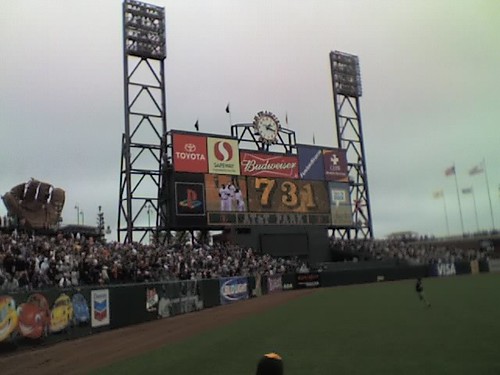
After all my trash talk about Bonds and how he should just fess up to the roids, I saw him hit a dinger last Saturday, and I actually cheered. Like, I stood up as it left the bat, and maybe even jumped in the air when it went out, all the while clapping my hands. It was irresistible. He hit the thing a mile. It was awesome.

Music / Peggy Honeywell at Mollusk

Flickr photo

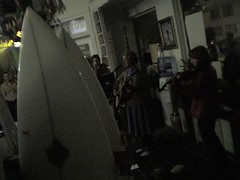
Being car-less keeps me (mostly) around the southeastern neighborhoods of San Francisco, but every once in a while I'll venture out to the frontiers. Last Friday, we went out to Mollusk, the arty surf shop on 46th-ish Avenue and Irving, (i.e. WAY Outer Sunset), for an art opening and a performance by Peggy Honeywell, i.e. local art star and beautiful loser Clare Rojas. The surf shop setting was informal and cozy; the acoustics actually weren't bad; there were dogs walking around; all in all, it makes me wish that I got out there more. This intimate setting was lots better than the cavernous, loud, obnoxious-people-filled place I saw her perform last, Barry McGee's opening in Melbourne, Australia a couple of years ago.

Thursday, September 7, 2006

My New York Times? Not quite.

The NYT just rolled out a beta of something they're calling MyTimes. As a daily reader of both the print and online editions, I'm intrigued by new developments and ideas at the NYT, and I've been pleased with their recent site redesign. MyTimes, however, strikes me as somewhat misguided.

First off, the name MyTimes sounds like a portal, recalling the confused era when every company wanted to make a my-prefixed version of their site. Unfortunately, it also evokes the subsequent realization that what people really wanted was not control over layout and content, but greater system intelligence -- smarter defaults, recognition of the things they normally do, a clever way of pointing them toward related things. The portal-sounding name wouldn't even be so bad if MyTimes didn't look and act like portal. Alas, it's got all sorts of crap to add and move around and modify, allowing the reader to add RSS feeds from anywhere on the web, view movie times, weather, Flickr images, whatever. To me, the problem is that the NYT isn't "whatever." It's the authoritative source. So why all the other stuff?

A better question: What problem is MyTimes supposed to be solving? What is the user goal is it addressing? One would do research to answer these questions, but -- to be self-referential -- my own goals in reading the NYT: Get the authoritative answer, enjoy great writing, forumlate opinions on complex problems. A major problem of MyTimes is that the NYT is trying to be both the authoritative source, and the delivery mechanism of any other source you might want.

So, my advice to the New York Times ...

  • Bring related information to me. Focus my attention to the news of the day, but make it easy to navigate to related things. These things may be within the NYT, or outside. Use what you know about me -- from observing my behavior -- to point me toward related things. Think Amazon, not Google Homepage or MySpace. Amazon remembers what you like, points you toward related stuff, tells you what other people have looked at, etc. It knows you; you don't HAVE to tell it anything.

  • Don't create a separate place that requires configuration and expect that I will go there and wait for the information to start rolling in. The established framework works: Start at the homepage, drill to the detail. Why create another starting place?

  • Integrate the good things from MyTimes -- the journalist pages, for instance, are a cool idea, and they are most appropriately accessed within the existing framework. Localized content like weather and movie listings are fine, but I don't understand why this needs to be separate from the existing framework of the NYT pages. Basically: Integrate the reader into the NYT, don't create a separate place for him/her. Learn my zip code, remember it, push relevant local content to me. End of story. (And just because Flickr has an RSS feed doesn't mean it's worthy of your brand. You're the New York Times! You've got the best photojournalists in the world! Get rid of it!)


While I'm on the subject, two additional things I'd like to see ...

  • More exposure to the Times' excellent archival journalism. Why not plumb the back catalog, and expose some of it to the readers? Many articles about current events refer to past events. Why not provide a list of related links to previous articles more often? Of course, I'd expect that this content would be free -- not only because I'm a cheapskate -- but because I would think it would pique people's interest in seeing more of it, which would of course cost money.

  • More journalist blogs and discussion. The Public Editor's column has become one of my favorite parts of the paper, and he blogs about interesting journalistic issues as well.Here's a great one about Nicholas Lemann's article about citizen journalism in the New Yorker.


In any case, there are roughly one thousand web sites offering up customizable info widgets, web-wide RSS feed aggregation, and so forth. The NYT should continue to focus on the content, and leave the aggregation to someone else.

Tuesday, September 5, 2006

Street art / Swoon

So it seems I'm a couple of years late to this particular artist, but some recent conversation on the Book Arts list turned me on to Swoon, a NYC street artist. Her medium is the cutout -- from paper, wood, linoleum -- and she attaches these to walls all over NYC. The paper ones are the most amazing to me; they're like those snow flakes you make in grade school, but life-sized and really elaborate and of people. Check out this Flickr cluster to get a sense of the way that the paper ages on the wall, and the way that this fragility and sense of impermanence reacts with the rest of the wall.

This interview in the Morning News has some good detail about her process:
There’s something particular to the images that make me choose that material ... A lot has to do with the limitations of the material. The linoleum you can get so much more detail from. Everything that has more nuances, I use linoleum. The wood is rougher, but a good roughness. The paper is really hard to think about, and so it tends to be simpler. With paper, you’d choose simple subjects because it’s hard to create an expression. The challenge is to make the cutout so that it can get on the wall as a solid unit in two minutes or less.

Thanks to howmuchlongerkillmenow for the photo.

Friday, August 25, 2006

Architecture / Daniel Libeskind's sauna

A few months ago, the NYT Sunday magazine ran a profile of architect Daniel Libeskind and his Tribeca loft. (Incidentally, check out that link to his website; there's some pretty hot flouting of web conventions. For example, when you mouse over a link, almost everything on the screen disappears, except a few stray words and the other links. Hmm.) Anyway, the most memorable part of the magazine article was a photo of the interior of his sauna. In it was a very small window, perhaps 18 inches high by 4 inches wide, and through that window the saun-ee could achieve a compactly framed view of the Chrysler Building. How cool is that? The image here shows the architect's rendering of the different landmarks visible from vantages within the loft. Neato.

Thursday, August 17, 2006

Radio / The best interview ever

NPR recently did a great story about John Sawatsky, a former journalist who now teaches interviewing techniques to editorial staff at ESPN. Highlights include Sawatsky's obvious dislike for "hard-hitting" interviewers like Larry King, Barbara Walters and Mike Wallace: "Mike Wallace enjoys ... having the question being more important than the answer." Other resources with other targets: Poynter article in which his method is applied White House correspondents, AJR article skewering Sam Donaldson.

The NPR site has loads of interesting additional resources related to the interview, and in a section called "What Makes A Good Interview," you'll find Sawatsky's nomination for the greatest interview of all time. The link is called "CBC Interview With Trucker About Beaver Attack." A sample:


"So ... how did you get this beaver off of you, eventually?"


"Well, I happen to have propane in my truck, so I have a seven-eighths open box-end wrench, and while he [the beaver] was hangin and chewin back there ..."


This piece got me thinking because interviewing and storytelling are important parts of our design process at Cooper. Early in projects, we interview a lot of people, including current and potential users of the product we're designing, experts in the field we're working in, and anyone who may be able to help us understand the background and context of the design. The goal is to build an understanding of the design problem from a human perspective, and to do this we need to get our subjects to open up, to reveal motivations and needs, the deep, personal stuff that underlies the things we do everyday.


Sawatsky's method is pretty much exactly what we try to use: simple, short, open-ended questions, giving space and time to the interviewee to breathe, think and respond. Poynter has some exercizes to get you thinking about how to conduct more effective interviews.

Thx to JK for getting me started on this.

Wednesday, August 16, 2006

Bikes / Key ingredients for interactive bike maps of the future

Flickr photo

ByCycle and Bikely both bring bike route mapping to the web, and not a minute too soon. Finding bike routes through cities (especially unfamiliar cities) can be a lonely, scary process of elimination. After much experimentation, the best route often ends up being a patchwork of quiet side streets, alleys, and paths that would be impossible to piece together in advance on a map. Ideally, you'd get to share ideas and information with other cyclists when you're trying to, say, get from the Mission to the Exploratorium for the first time. Yeah, straight up Van Ness is probably not the best way, even though it looks like it on the map.

Online communities to the rescue, right? MySpace and Wikipedia are doing something right; they've both found ways to tap into the motivations of a particular group of people, providing forums to share information and build connections. Exactly what each has done right is anyone's guess. MySpace is ugly, confusing, often annoyingly inconsistent, and generally unusable. Wikipedia is unreliable, badly written and pretty much a total free-for-all. So the bike route mapping thing doesn't need to be perfect, it just needs to provide the right environment and functionality to do the following things:

  • Easily post routes. Use the power and knowledge of the bike community to record the best routes around the city. Bikely does this, and they've built a simple, mostly straightforward process. I created a route of my Summits of San Francisco run/ride, and it pretty easy, though the are some fairly unconventional interactions. Kudos to Bikely for getting my mind going on this.


  • Edit and annotate any route. Leveraging the knowledge of the group requires an approach like Wikipedia's. Each route should be editable, and annotate-able by the community. This is the only way to get discussion started.


  • Emphasize tagging and categorizing routes over naming. Bikely is very free-form right now, and posting routes has quickly become a free-for-all. They recently added tagging, but it's fairly constrained to a few route attributes -- recreation, commuting, urban, rural. A more Flickr-like model, where one tags can be anything related to the route (marin, tiburon, ocean, golden gate bridge, etc), gives people the ability to make their routes findable by their important characteristics. Of course, as much tagging as possible should be automated -- the route length, the streets covered, the cities visited -- all of this should be extractable from Google Maps, right?


  • Distribute admin privileges to local experts. People have posted routes that are almost identical, named them different things, and therefore searching for routes brings up lots of repetitive junk. Here's where Wikipedia provides a good way of allowing the community to police itself. A dedicated San Francisco cyclist could ensure that classic routes are established and maintained.


  • Provide inline discussion of routes. An additional problem with lots of people posting similar routes is that they're missing the opportunity to have an interesting discussion about that route. There IS knowledge out there that can be brought to the fore! Like Wikipedia, each route should be editable, and those edits of course should be revertable, and there should be a forum for discussion about the route.


  • Allow people to support routes. This is the sixth item, but it's really one of the most important. People should be able to join or approve routes, like "friending" someone in MySpace. This is where MySpace comes in. By "friending" a route, so to speak, you give it your approval as safe, really, and you also begin to build your own profile ...


  • Provide a user profile page. It's an essential component of MySpace, Wikipedia, Flickr, del.icio.us, etc. People love themselves. They like to aggregate stuff. This site doesn't need to be MySpace, but it does need to provide the notion of a profile, where a user can share something about themselves, and view the routes they've joined or friended or whatever.


There must be more, right?

I got to thinking about this after reading these two interesting pieces on worldchanging.org: ByCycle - Online bike maps and Making Bicycle-Friendly Cities.

Saturday, August 12, 2006

Food / Lakes and cheeseburgers along the PCT

Lakes and cheeseburgers in Oregon
Lakes and cheeseburgers - California
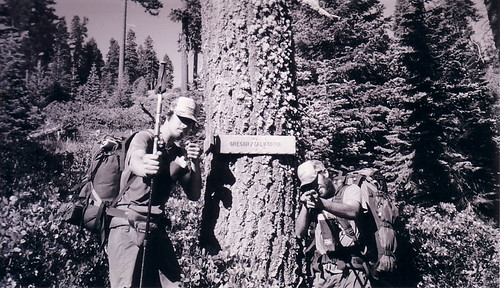
During my hike on the PCT in 2001, my two favorite pastimes were swimming and eating. When I was walking -- which was most of the time -- cool swimming holes and sizzling cheeseburgers filled my daydreams. When my hiking partner, Nick, and I talked, it was more often than not about swimming and eating cheeseburgers: How far to the next river, creek or lake? How long would it take to hitch out to get a cheeseburger at the next road crossing?

As the two attached lists indicate, we found lots of chances to follow these particularly blissful pastimes. Cheeseburger-wise, the best were found in the Cheeseburger Belt, which begins as the Sierras give way to the Cascades in northern California, and ends a little north of Ashland, Oregon. The best of the best in the belt were found at Buck's Lake Lodge near Quincy, the Pines Frosty in Chester (which also has kick-ass shakes), and Lake of the Woods Resort north of Ashland. At the bottom of the list was Belden Town, which shouldn't really be surprising since they don't seem to like hikers too much anyway.

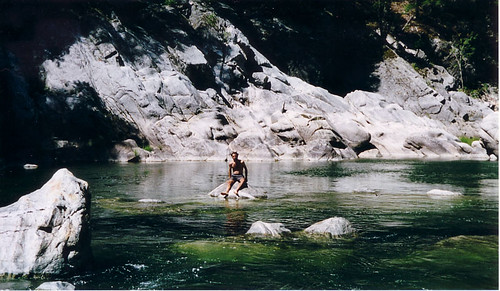
The best of the swimming was between in northern California, between Sierra City and Etna. The Middle Fork of the Feather (pictured below) was spectacular, though Nick preferred Squaw Valley Creek, which he found a little cozier.

Flickr photo


Personal history / Pacific Crest Trail five years later

PCT diary entry - August 10, 2001 Five years ago today, I was hiking on the Pacific Crest Trail. I spent the summer of 2001 hiking through California, Oregon, and Washington; on the 12th of August, I was chilling out at Crater Lake, Oregon.

Crater Lake had been a really major destination for me, not because of its legendary, otherworldly beauty or because I'd never seen it or because I was looking forward to bumming beers off retirees in RVs, but BECAUSE I was having a new pair of shoes delivered to the PO there. My feet, at that point, were thrashed. The trail can be unkind to feet in a variety of ways -- extreme heat in the south, frequent river crossings and snow in the Sierras -- and it doesn't help when you wear one pair of Asics Gel Trabuco III's for the last two-thirds of the state of California.

I take a look at my PCT journal a few times every summer; the entry scanned above represents some of the happier times on the trail. A little earlier in my hike, the heat and drudgery of Northern California would have figured more prominently. The words "heat rash" would have appeared, and I also would have mentioned the fact that my girlfriend was breaking up with me. Later in the hike, my hiking partner, Nick Brown, broke his ankle and some religious zealots crashed commercial airplanes into American landmarks.

Reading over it now, August 12, 2001 represents a distant little period of serenity and calm. My days were pretty simple: How far should I hike today? Where will I get water? Should I stop and take a swim while I'm there? When should I eat my next snack? Should I take this alternate route? Should I stop early? Should I night-hike? Where will I get my next cheeseburger? It amazes me that it ever could be so easy ... The picture below was taken a few days before.


Flickr photo


Tuesday, July 11, 2006

Music / Bob Dylan - Ten of Swords

Flickr photo


Last weekend, my friend Greg invited me over to listen to his copy of Ten of Swords, the classic 20-side Dylan bootleg. It contains a comprehensive -- no, exhaustive -- selection of live shows, alternate takes, and demoes from Dylan's most groundbreaking years -- 1961-1966. The highlight is the infamous Manchester show from 1966; it's filled with murmuring disapproval of Dylan's electrification and reaches a climax when an audience member shouts "Judas!" right before the band kicks into "Like a Rolling Stone." (A side note: One of the most satisfying things about No Direction Home, Martin Scorsese's biopic of Dylan, is the revelation that Dylan, after hearing the taunts, shouts to his band: "Play it fxxking loud!" as they launch into the song).

Since the release of Ten of Swords, many, if not most, of the tracks (including the entire "Judas!" show) have been mined by Columbia and assembled into official releases (with better sound quality, it should be said), but this didn't dampen the thrill of hearing tracks like "I Was Young When I Left Home" on the original, illicit vinyl. All I could think afterwards was: Thank goodness there was no eBay during the height of my Bob Dylan craze.

UPDATE: An informative Salon article about the 2004 release of the Rolling Thunder bootleg.

UPDATE: Damn you, eBay! As I was getting a sense of what Ten of Swords might cost nowadays -- curiosity, nothing more, I swear -- I noticed a Beatles bootleg set called The Complete BBC Sessions, a sort of Beatles-oriented Ten of Swords in response to the official version called Live at the BBC. The numbers: 10CDs, 239 tracks and a variety of chatter on the Complete Sessions to 2CDs, 60+ tracks, a little chatter on the official release. This NYT critique of Live at the BBC issues some pointed criticism at the Beatles' label: "While Apple has fiddled and litigated, bootleggers have catered plentifully to collectors interested in these things."

Thursday, June 8, 2006

Food / Park Slope Food Coop

Flickr photo


Like most things in New York, the Park Slope Food Coop is exclusive, filled with beautiful people, and a source of high drama in the lives of everyone involved with it. Most everyone I know in Brooklyn is a member, and all of them are on some sort of weird coop probation because they're behind on their shifts. Skipping shifts is really naughty, and the lengths to which some members will go to get out of them has become the stuff of folklore. On the other hand, others seem almost pathologically conscientious -- in a recent issue of the newsletter was a story of a member who had written into the coop to explain his absence. You see, he was in prison for eco-terrorism. So he may not, you know, be able to cover that Tuesday afternoon produce sorting shift.

Tuesday, May 23, 2006

Google calendars & World Cup

I've been bugging out on Google calendars recently, and I found a really nifty one for this year's World Cup. Others: Bottom of the Hill shows (rock n roll!), Giants games (hey, batter), Dolores Park movie nights (bring: jacket, beer).

Friday, May 19, 2006

Alone in Houston

Flickr photo

I put some new photos on my Flickr page recently. This one is from a recent trip to Houston. I took it while driving around (I believe it's called) The Beltway. The photo makes Houston seem empty, which, as I recall, is like the opposite of what it is. Especially the freeways. I don't recall more than a few moments when I wasn't sitting in traffic. Which makes me wonder: Did I really take this picture? How did it get into my phone?

Silver Jews / 27 goes into 50,000

In the Silver Jews song "Trains Across the Sea," there's a line that goes: "In 27 years, I've drunk 50,000 beers, and they just wash against me like the sea into a pier." That's 5+ beers a day from birth until your 28th birthday. If you start at 16, you're drinking a 12-pack a day to get there. (I didn't account for leap years, actually, so you'd have 2-3 days to let your liver recover during those 11 years).

Recently, I came across a diary I kept in 1994, the year I moved to California. I was clearly obsessed with the Silver Jews at the time, and I'd done a little math in the margin to calculate how I matched up to them, beer-wise. (I was 22 at the time). Shockingly, I found that I had to cram roughly 40,000 beers into the next 4.5 years. That's a little over one case per day, everyday, i.e. a true 24x7 sort of endeavor. Did I make it? Short answer: No. However, I did predict that I'd be getting there by the time I was 33, my current age. Am I there yet? In my estimation, no. Probably not, anyway. My revised calculations put me at the landmark somewhere around my 43rd birthday. I'm coming for you, Dave Berman! Watch your back!

Thursday, May 18, 2006

Music / Sasha v Stephin

Stephin Merritt doesn't like hip-hop, which is fine, but he made the mistake of assembling a playlist for the NYT that included no black artists, thereby awakening playlist affirmative action policeman, Sasha Frere-Jones. Actually, SF-J has had issues with Merritt since 2004, but now he's throwing down and calling Merritt a "rockist cracker." Not to be confused with a "racist cracker," though he implies as much. The NYT nicely documents the origins and recent developments of the feud, and John Cook defended Merritt in Slate last week. What the blogosphere is saying: Jessica Hopper's tinyluckygenius (on Merritt's own role in fanning the, umm, flames), Jane Dark's Sugarhigh! (on the big picture).

Bike-to-work day 2006

Today is Bike-to-Work Day, which means that Market Street was slightly more alive this morning. As everyday is bike-to-work day for me, I would really rather see the "energizer stations" (PDF map of the Bike Coalition's coverage) out there during the winter, when the wind is howling, the streets slick, and the cyclists few in number, but still, it's nice to see a few more people out there dodging potholes and Muni tracks, and the snacks were tasty. Thx, SFBC.

Tuesday, May 16, 2006

TV / Wes Anderson's Amex ad

"Why would I put on a hat if my best friend just got blown up in front of me?" An excellent question posed by Jason Schwartzman's character in Wes Anderson's excellent Amex ad. In just under two minutes, the ad encapsulates the brilliance of Anderson's vision: it's filled with snappy dialogue, exquisite production design, and perfectly pitched non sequitors. It begins with a car explosion. Anderson shouts "Cut!", acknowledges that it's an ad ("Anyway, American Express ad"), and poses the question, "Making movies. How do you do it?" He then strides through a series of vignettes while attempting to give directions: "First, think up a good story," but he's then interrupted by a PA who wants to introduce him to the daughter of a man who loaned the a sportscar to the production. "Two, how do you tell it?" he says and then directs a propmaster to put a bayonette on a .357 magnum. "Next, there's your collaborators," while a PA is telling him that the producers won't pay $15000 for a helicopter rental. As he prepares for the next shot, he concludes: "You mix it all together and that's more or less it." Slate posted an admiring review yesterday.

Thursday, May 11, 2006

Baseball / Bonds-ron

As Barry Bonds approaches Babe Ruth on the lifetime homerun list, he's getting a heckuva lot of ambivalent coverage: Veterans express ambivalence and skepticism (SI), even San Franciscans souring on the event (AP via ESPN), but baseball has seen worse, though not by much (ESPN). I figured I'd do some first-hand investigation this afternoon, so I rode down to AT&T Park during lunch. When Bonds came up to bat, there was the requisite "Bar-ry, Bar-ry," but even this seemed pretty half-hearted, like everyone felt that they kinda had to chant along. Cynical comments rippled through the crowd. It seems weird to say this, but maybe you don't have to like Bonds as a person to feel drawn to his achievement. Or, how about this: Maybe there's a whole different kind of enjoyment that one derives from watching villains break records? Whatever it was, it was definitely not 2001 all over again, when a Bonds at-bat sent palpable electicity through the crowd. In 2006, it's more akin to watching Enron execs lie their asses off in court.

Tuesday, April 25, 2006

Liz Christy garden / cradle of urban gardening

Flickr photo


The roots of (modern) urban gardening can be traced to the Liz Christy Garden on New York's Lower East Side. (Some good 70's photos of urban hippies getting their hands dirty). When I visited, the cherry blossoms were going off.

Monday, April 24, 2006

Architecture / 560 Mission

Flickr photo


I ride down Mission Street everyday, and I always admire the JP Morgan Chase building at 560 Mission between First and Second Street. Most buildings in downtown SF are earth-toned, and riding among them can feel like flashing back to the Gap in the early 90's -- putty, mauve, beige, taupe, moss. In contrast, the Morgan building has black steel-and-glass facade with a greenish tint, pleasantly blending erector-set orderliness with an aquarium-like glow. Today I found out it was designed by Cesar Pelli, aka the guy/firm behind the Petronas Towers. Each architect in this review of recent architecture in the SF Business Journal describes 560 Mission as their favorite recent SF project.

Saturday, April 22, 2006

Architecture / CIGNA HQ

Flickr photo


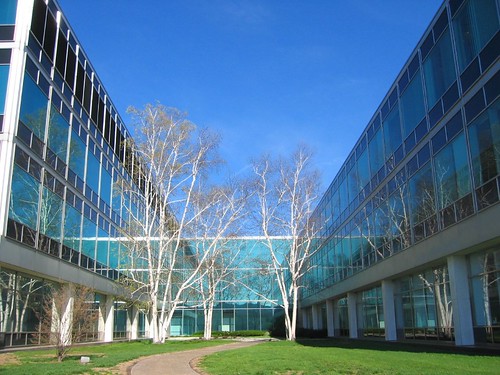
Located among in suburban Hartford, CT's office parks, strip malls and golf courses, the corporate headquarters of CIGNA are unexpectedly cool. Reason 1: A ROBOT delivers mail to each department. Reason 2: The building itself is low-lying and sleek, with green-tinted windows that, on sunny days, disappear into the sky. It was designed by Gordon Bunshaft, who also designed the stunning Beinecke Library at Yale and won the Pritzker Prize in 1988, and it's surrounded by gardens, courtyards and sculpture by landscaping badass Isamu Noguchi. A couple of years ago, CIGNA considered tearing the building down and selling the land to a golf course developer, but architectural preservationists intervened. CIGNA staffmembers often joked about this, the subtext being, "Can you believe that anyone would want to preserve this?" [A NYT article from 2001 details the debate]

UPDATE: The Hartford Courant recently published a grateful editorial about CIGNA's decision to preserve the Bunshaft building.

Art / CIA HQ

Outside CIA headquarters, there's an installation called "Kryptos," a large metal sheet containing a series of characters that has perplexed puzzlers since it was unveiled 10 years ago. Today, the NYT reports that the artist mistakenly omitted a character.

Wednesday, April 19, 2006

Tuesday, April 11, 2006

Kansas basketball / Another early exit

FOR THE LOVE OF GOD WHEN WILL THEY STOP TORTURING ME?

Once again, the Jayhawks exited the NCAA tournament in the first round; this time, it was a 77-73 loss to Bradley, marking the second year in a row in which the heavily-favored Hawks were up-ended by a lower seed.

What the hell went wrong? Bradley came out loose and snappy; the Hawks looked spooked and tight. A couple of unlucky early possessions tipped the momentum toward Bradley, and you could see the Hawks get somewhat prematurely discouraged and frustrated. Up until the very late second half, the vaunted Jayhawk defense -- which had created easy offensive opportunities all year -- struggled to keep up with Bradley's relentless inside-out attack. All year, Kansas had locked down their opponents, forcing bad shots and racing it right back up their opponents' backside. This time, they played Bradley's game for almost 40 minutes.

The most confounding part was that they seemed so out of sync. The stars from the Texas game fell victim to the fumbles and hiccups that characterized the early season. Julian Wright disappeared for minutes on end; Mario Chalmers couldn't get anything to fall in the first half; Sasha Kaun's shots got some tough treatment by the rim, and then, man, what happened? And JHawk, well, you just knew that he wouldn't repeat the 4-for-5 shooting from three point range. Without RussRob, the Hawks would have never been in the game.

Nevertheless, late in the second half, Self went with three guards, and the sudden, swarming defensive pressure paralyzed Bradley's offense. Chalmers and Robinson created turnovers, shredded Bradley's defense and -- BAM -- we got a quick glimpse of what could have been a 25-point cakewalk on another night. The Hawks just totally overwhelmed the Bradley backcourt for the last 7 or 8 minutes, and improbably the game was within reach.

Then, heartbreak. The Hawks created another turnover, and brought the ball upcourt, down by three with a little over a minute left. Hawkins comes around a screen. He's got an open look. DUDE, KNOCK IT DOWN! It looks good when it leaves his hands. The ball is arc-ing toward the basket. I'm in a hotel room in Albuquerque, standing on the bed with my arms raised in three-point/field goal formation, and I'm remembering the Missouri game from 2003 when Aaron Miles hit a long, contested three as time ran out to win the game, WHICH I ALSO WATCHED FROM A HOTEL ROOM! SYNCHRONICITY! and I'm not breathing, and my heart is pounding GO IN for God's sake! NO! Rebound! NOOO!

Alas.

Was it worse than last year? I would say yes. Last year's team partially imploded in the late season, limped out of the Big 12 tournament, and rolled over somewhere en route to their first round game. This year's team, though. I don't think I was the only one who was having visions of the Fab Five dancing in my head. For days after, I mourned both my bracket (in shambles), and what could have been a victory over Pitt, a domination of Memphis, and a rocking good game against UCLA. LSU would have been a problem. Within seven or eight feet of the basket, they were tough; outside of that, inept. Could the Hawks have stopped them enough in the paint for that to matter? Perhaps.

Thursday, April 6, 2006

Free WiFi to roll into SF

Flickr photo


So apparently Google and Earthlink are teaming up to provide free WiFi service to all of SF (via Gizmodo). While we're still a ways from knowing what this will actually mean -- mainly, will be accessible at 14th and Valencia, third floor apartment? -- it is intriguing to me that Google is involved. Unlike Earthlink, Google has never gouged me, or failed to provide service that I've paid for, or sold my name and home address to direct marketers.

So I guess you could say that I'm hopeful. Maybe someday soon I'll be able to work from Pac Bell (er, I mean, SBC ... er, I mean AT&T) Park, or Buena Vista Park, or the little redwood grove outside the Transamerica building.

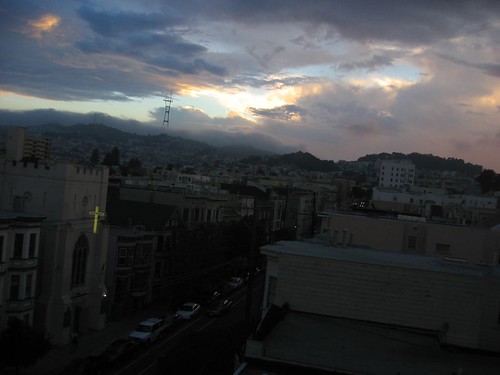
Or from my roof. (See the photo).

Tuesday, April 4, 2006

Kirby Puckett, 1960-2006

In the fall of 1990, I went to see a Twins-Royals game in the Homer Dome. Do I need to mention that the Royals were not contending for a playoff spot? They weren't, and neither were the Twins. There were approximately 1000 people there, but the rare assortment of players on the field has made the game stick in my memory. Royal legend George Brett was locking down a batting title in a third decade.[1] Bo Jackson was about to play his last baseball game at full strength. And Kirby Puckett was in his prime, smiling, clowning, and inspiring even the Royals fans (me and my friends) among the crowd to cheer for him.

My friends and I had an entire left-field section to ourselves, and the Metrodome's infamous acoustics combined with the absence of people provided my friend Adlai with a rare opportunity to ensure that Twins fan favorite Dan Gladden heard his every comment about his mullet. It also afforded us an opportunity to hear Kirby clowning around with people in the center field bleachers. At that point, no one could argue that Puck was anything but a great guy. He was fun; the Twins were good; the Twins infamously fair-weather fans didn't really seem to appreciate him at that moment, but he didn't let it get to him.

A little over a year later, his heroics would propel the Twins to another World Series championship, and his leaping Game 6 catch, combined with the game-winning dinger, would comprise one of the great all-time clutch performances. Everything after that seemed out of character.

[1] At this point, this seems even more remarkable than it did then. Seriously, who else is going to pull that off? Todd Helton in 2011? Maybe, but not likely.

Monday, April 3, 2006

Books / Game of Shadows

I was just watching ESPN's Opening Day coverage of the Braves-Dodgers game, and the conversation between commentator Erik Karros (wasn't he Rookie of the Year like 5 years ago?) and Rick Sutcliffe turned to steroids. Karros couldn't contain himself. He blustered and rambled for a while, criticizing those who demanded an investigation, and basically rehashed Mark McGwire's non-denial denial to a Senate sub-committee: Steroids were abused in the past; the league has adopted a stricter policy; let's all move on. The message was unoriginal -- a lot of current players don't want to dwell on this unsavory development -- but the air of defensiveness mixed with disdain seemed oddly reminscent of another guilty, defiant person -- Donald Rumsfeld.

Anyway, over the past couple of days, I tore through Game of Shadows, the recently published steroids expose by Mark Fainaru-Wada and Lance Williams. After a month of PR build-up and published excerpts, there weren't many surprises:

  • Bonds availed himself of steroids. One might say, a buttload of steroids.

  • So did Marion Jones.

  • They're both liars.

  • So are a lot of professional athletes.


Bonds is the big story in Game of Shadows. If you couldn't already tell by his cartoonishly swollen neck/head and his late-career power explosion, Bonds hasn't been playing fair. He admitted to a grand jury that he allowed his trainer (a known juicer) to place droplets of an "unknown" chemical under his tongue, and to rub an "unknown" cream on his joints. Bonds thought that these were legal supplements -- the drops were "flaxseed oil" -- yeah, he actually said that -- and he implied that he'd never injected anything. Uh-huh, yeah. I'm a fan of the flaxseed oil, and I can testify that it doesn't make your head become like 5x bigger. Plus, Bonds has always been a control freak. Is it even remotely possible that he didn't bother finding out what his trainer was sticking in his mouth?

The book reveals the Bonds was on a steroid regimen that included more than "flaxseed oil," making it seem even more likely that Bonds perjured himself in front of the grand jury. Sources close to him indicate that he was on all sorts of injectable crap, including Decadurabolin (in the butt) and human growth hormone (in the stomach). He wanted us to believe that it was all free weights and sprints and vitamins, but it makes a little more sense that there was some secret sauce in the mix.

A personal note: Barry, dude, seriously. Just freakin admit it. You're like a little kid sitting in a pile of cookie crumbs, crying and claiming that you didn't eat any cookies. It's undignified, really. Say "I took steroids because I wanted to win, because everyone else was, because it's what I had to do." Fans understand competitiveness, and you're a competitive guy, and steroids weren't against the rules anyway. So just fess up, you big baby. At some point, you could even ask for our forgiveness. I mean, it's possible. You always claim that you're not given the respect you deserve. Here's your chance to earn it.

Tuesday, March 7, 2006

Movies / More Oscar crap

Of course Crash won Best Picture. Why wouldn't Academy members -- I'm assuming they're mostly white and Angeleno -- rally around a film that momentarily relieved them of guilt they feel for living in such a racially segregated city? (I have to admit that I love Ludacris's rant about the racial implications of riding city buses. That, and Don Cheadle's opening, were the only moments in the entire movie that weren't heavy-handed, cheesy, or gag-inducing).

The Morning News has a great list of quotes from other reviewers who disliked the movie as much as I did. A sample: "Contrived, obvious and overstated, Crash is basically just one white man's righteous attempt to make other white people feel as if they've confronted the problem of racism head-on."

Monday, March 6, 2006

Truth, fiction, the Village Voice, Sylvestergate

Village Voice writer Nick Sylvester joins the ranks of defamed young journalists with his recent foray into research fabrication -- i.e., he basically invented a (mostly unremarkable) scene that neatly summed up his thoughts in an article on Neil Strauss's The Game and its effect on NYC dating culture. The obviously weird thing is that the "research" he faked was the kind of thing that most young reporters would not even think of as "research." An assignment requiring lots of time in bars and nightclubs, watching people hit on each other? That's the kind of embedded journalism that a (now former) music writer should be able to handle, right?

Disappointly, he doesn't really do much with the lies and deceit, making Sylvester the writer roughly 2000% less interesting than Stephen Glass who at least endeavored to write a riveting story with his fakery. It's also clear that Jayson Blair's jockstrap is still in need to transport when one finds that Sylvester quotes real people who he never, umm, interviewed.

A note of reality: It's worth pointing out that the juvenile bs foisted upon us by Pitchforkers past and present simply enhances the excellence of journalism that matters from people like him, her, and her.

Saturday, March 4, 2006

Art / Richard Misrach slays 49 Geary

Hazardous wasteFirst Thursdays at 49 Geary can be overwhelming, people-wise, and underwhelming, art-wise, and this month was different only in that the overwhelmingness was crammed into one place: the Fraenkel Gallery. Packed with people, it also displayed a face-melting collection of Richard Misrach photos.


When I first saw Misrach's photos, I thought immediately of Sebastiao Salgado. Both guys address big themes -- civilizations, seasons, landscapes, human endeavors -- but they do so in vastly different ways. Salgado frames his work around human action; his subjects are migrants, activitists, laborers. Misrach works with earth, light, space; he works with dunes, strangers, cars, power plants. Salgado's work is tied to current events, political movements, regimes, definable moments and recognizable things; Misrach works with more anonymous objects and landscapes. There are much more significant differences between them, but they share a social awareness that invests the best of their work with real intrigue and importance.

Art / Oakland is special in other ways

Flickr photo
Last night we checked out the Oakland Art Murmur. Actually, we didn't even know that such a thing existed, and drove over the Bridge intending to see Jason Munn's opening at Bloom Screen Printing. So it was a pleasant surprise to see that little stretch of Telegraph goin off when we got there. Jason's stuff was the best of the art stuff, by far, but the action on the street was out front of Rock Paper Scissors.

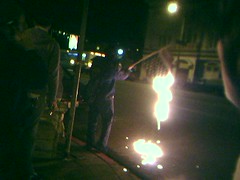
That's where we saw a guy burn an American flag. It took him roughly 10 minutes of false starts to light it with a Bic, but just after I took this picture, an ambulance raced up the street, sirens blaring, on its way to some emergency, but it abruptly slowed down when the driver saw the burning flag, and we could see the faces of the other paramedics staring at the guy as they crawled by. It was one of those only-in-Oakland moments. Holla!

Thursday, March 2, 2006

SportsCenter catchphrases & their usage contexts

I watch so much SportsCenter that I figured I'd try to chronicle the non sequitors that they use to punctuate excellent sports moments.

  • Three beers apiece for my co-workers -- While high-fives among teammates are being exchanged. Derivation: Shawshank Redemption

  • What's on the grill? -- Punctuates the moment when someone, usually Dwayne Wade, dunks in someone else's face, i.e. "Jason Collins, what's on the grill?"

  • Pay for my dry cleaning! -- Accentuated a Vince-Carter-administered NBA playoff dunk. Derivation: SNL

  • Bartender! Johnny Walker Red. -- Highlight involving the Cincinnati Reds.

  • _____ has powers comparable to Wonderboy! -- Fill in the blank with any player who is about to do something amazing in the highlight reel. Derivation: Tenacious D.

  • That's levitation, homes. -- Dunk that could otherwise be described with the words "helicopter," "windmill," or "tomahawk," or any dunk by Vince Carter or Andre Igoudala in the month of December 2005. Derivation: Tenacious D.

  • Bartender! Canadian Club. -- used in conjunction with the Blue Jays, Raptors, or any Canadian NHL team.

  • Get to the chopper! -- Variously applied, e.g. Albert Pujols has just hammered the crap out of the ball and is beginning to trot around the bases; Ben Wallace has completely plastered an opponent's dunk attempt and is sprinting back downcourt, where he receives an alley-oop from Chauncey Billups and throws it down in some guy's face; Julius Peppers has just sprinted 20 yards in approximately 1.5 seconds in order to light up a quarterback. Derivation: Predator

  • Bartender! Shot of Jack. -- This, I think, was the original "Bartender" exclamation. Usually used in connection with a homerun.

  • Bartender! Cuba Libre -- Introducing any story involving Cuba during the World Baseball Classic.

  • Kill me, I'm here! -- General exclamation. I've only heard this one once, and it accompanied a hockey highlight. Derivation: Predator

  • That's it and that's all. -- Usually to punctuate a player's execution of a coup de grace, e.g. "Allen Iverson's three in the closing seconds puts the Sixers up for good. That's it and that's all." Derivation: Lil Sis

  • (Always in progress)

Tuesday, February 21, 2006

Art / Jesus drives Satan from his toy room

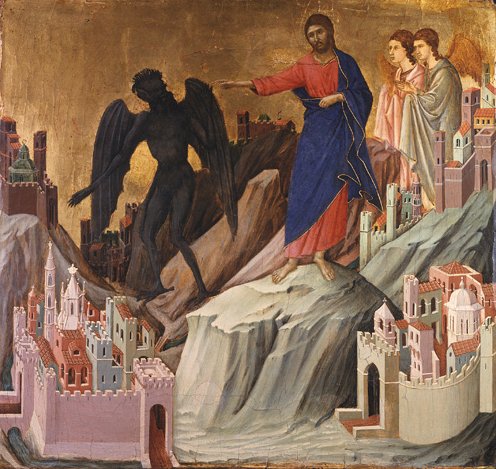
A couple of weeks ago, Mara and Jonathan and I went to the Frick, where we saw this painting by Duccio. It's called "The Temptation of Christ on the Mountain," but I vastly prefer Jonthan's title (hint: it's the subject of this post). Incidentally, how great is the Frick? Ghostly Whistlers, multiple Vermeers, "St. Francis in the Desert," an excellent sculpture of a dead bird (was it a bird?). One might say: Frickin awesome.

Thursday, January 19, 2006

Art / Marcel Dzama, bats, root beer, Canada

The Royal Art Lodge snuck up on me. I wandered into a show of theirs at the Power Plant, a gallery in Toronto in 2003. In a fairly small space, they'd crammed a wall full of collaborative paintings, Polaroids, homemade musical instruments, and many paintings by Marcel Dzama and Neil Farber. It was all very ... hard to describe: thrown together, primitive, whimsical, charming, dark, strange, hilarious. A painting of debutantes sitting in a row on the back of an alligator, smoking cigarettes. Bats. Root beer syrup. A grid of Polaroids, each of which was composed of a person in a strange, homemade mask poking his/her head out of a window of an institutional building.

I couldn't quite believe it and I loved it. It would be hard for any art show to rival serendipitous discovery like that, but last week, I checked out Yerba Buena's show of some newer Royal Art Lodge stuff: Peer Pleasures 1. Worth seeing, like many recent YBCA shows. Not spectacular, but solid.

See also:

  • Lists of interesting stuff that Neil Farber and Michael Duomontier will swap paintings for (Neil: Micronauts from the 70's. Michael: self-released Joanna Newsom albums).

  • Marcel Dzama interview with Sarah Vowell: "If there is a Canadian factor in our togetherness, perhaps it is borne out of the isolation of living in a small city like Winnipeg, and the cold weather. We are not able to go outside too often because right now your skin will freeze within minutes."

Kansas basketball / The basics

I have irrational feelings about Kansas basketball, and this entry is a simple effort to contextualize and provide foundation for comments I will make as the 2005-6 season unfolds.

I grew up in Kansas. My grandfather, great-grandfather, dad, uncle, and aunt all attended the University of Kansas. My family had season tickets for both football and basketball games, and I spent a sizeable chunk of my childhood running around those stadiums. At football games, we sat on the 50-yard line, about 30 rows up from the field. For basketball, we sat courtside -- second row, actually -- behind the Kansas bench, Jack Nicholson-style.

Any fan of college sports will tell you that season tickets to Kansas football have never been in high demand, at least not in my lifetime. The last glory year for Kansas football was 1969, when they were edged 15-14 by Penn State in the Orange Bowl. My dad traveled to Miami for that game, and the story of profound heartbreak still stings, even though I wasn't there. The basketball Jayhawks had hay days in the fifties, again, well before my time, winning a national championship in 1952 and coming up one point short of another in a classic 1957 duel with North Carolina.

All of this began to change in 1984, when journeyman genius Larry Brown was hired as head basketball coach. He had not yet attained the status of wizard as he seems to have today, but Brown converted a team that had been run into the ground in the early 80's into a national title winner in the span of five years. The aftermath of his tenure wasn't pretty: he took a job with the LA Clippers after the title game and left KU to deal with the graduation of one a Jayhawk great (Danny Manning), and, umm, some NCAA sanctions that resulted in a year-long suspension from the NCAA tournament. The future looked bleak in 1989, even more so when the athletic department hired a relatively unknown North Carolina assistant named Roy Williams.

As it turned out, 1989 was merely the beginning of a 15-year run of basketball excellence. Salad years. Coach Williams proved to be an unquestionable master of the college game (an encyclopedic account of his achievements), patching together the team that remained after Brown's exit and leading them into the Final Four within two years and in the process creating a new style of offense that proudly bears the name, The Kansas Break. Accolades accumulated: Final Fours in 1991 and 1993. A nationally-televised 150-95 drubbing of Kentucky in 1989. One of the all-time great college basketball teams in 1996. More Final Fours in 2002 and 2003.

When Coach Williams returned home to North Carolina after the 2003 season, the question on everyone's mind was: Will 2003 be looked at as another 1989, or as another 1969? The beginning of a new era of greatness, or the beginning of a long decline?

Wednesday, January 11, 2006

2005 / The cities

Inspired by the list-makers here and here.

  • San Francisco

  • Kailua, Hawaii

  • Hilo, Hawaii

  • Hamburg, Germany

  • Amsterdam, Netherlands

  • Eindhoven, Netherlands

  • Munich, Germany*

  • London, England*

  • Cardiff, Wales

  • Washington DC

  • (A small town in the Italian Alps)

  • Alicante, Spain

  • Hong Kong

  • Sydney, Australia

  • Adelaide, Australia

  • Melbourne, Australia

  • Tokyo, Japan

  • Warsaw, Indiana

  • Chicago, Illinois

  • Kansas City, Missouri*

  • Leawood, Kansas

  • Asheville, North Carolina

  • Pittsburgh, Pennsylvania

  • McKeesport, Pennsylvania

  • Buffalo, New York

  • Niagara Falls

  • Toronto, Canada

  • Detroit, Michigan

  • Ann Arbor, Michigan

  • Kalamazoo, Michigan

  • Portland, Oregon*

  • Seattle, Washington

  • Austin, Texas

  • Puerto Vallarta, Mexico

  • Sayulita, Mexico

  • Peoria, Illinois

  • Gainesville, Florida

  • Atlanta, Georgia

  • Minneapolis, Minnesota*

  • Newark, New Jersey*

  • Basking Ridge, NJ

  • Springfield, Missouri

  • Las Vegas, NV


Holy crap. I had no idea that there were so many. Qualifying cities had at least one overnight stay, except Hong Kong, Pittsburgh and Detroit, where I spent most of a day and then escaped before night fell. Actually, I'm kidding; I really loved both of those cities, which is why I wanted to put them on the list. * indicates that I visited the city multiple times, usually in totally unrelated contexts.